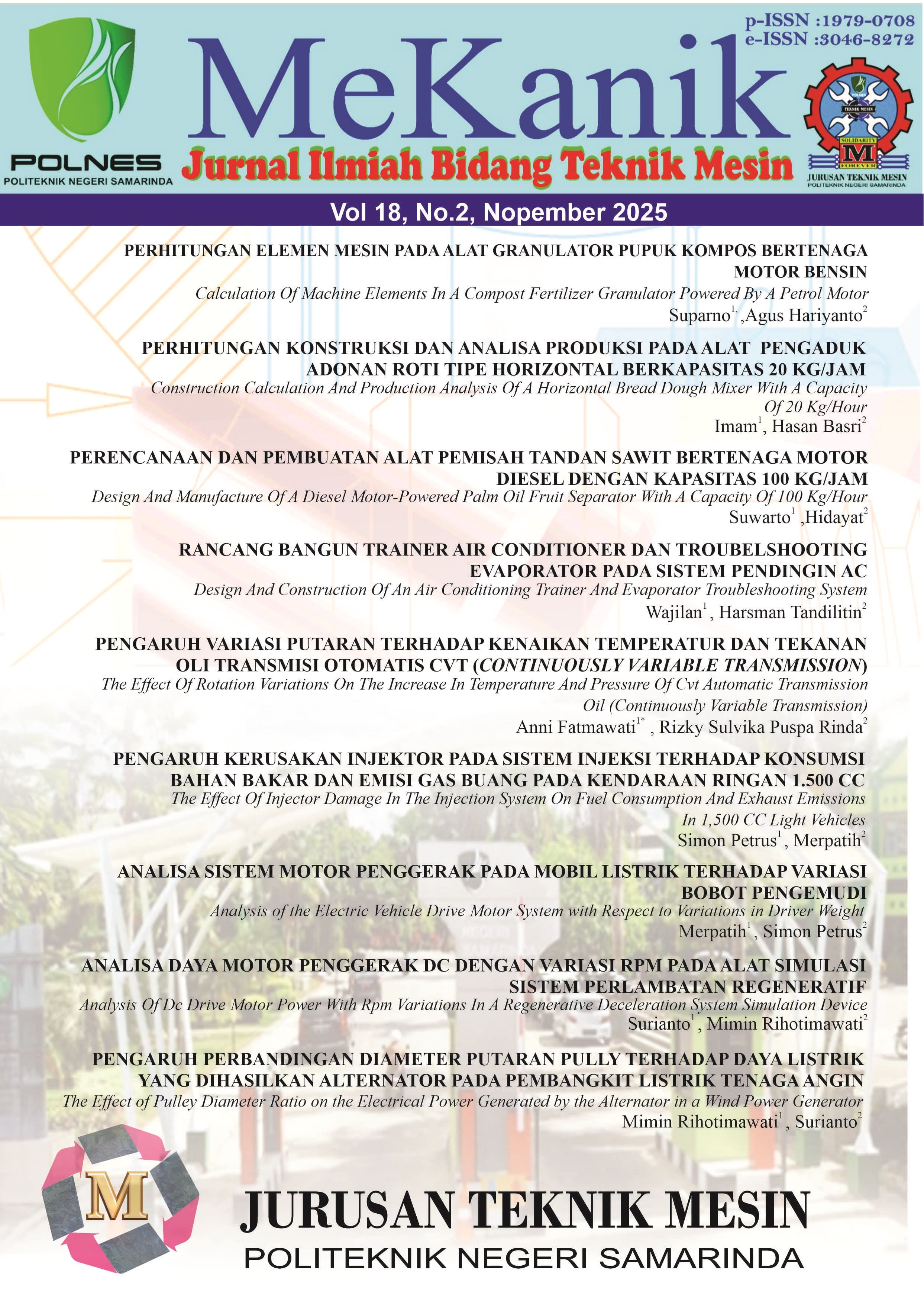
ANALISA SISTEM MOTOR PENGGERAK PADA MOBIL LISTRIK TERHADAP VARIASI BOBOT PENGEMUDI
Analysis of the Electric Vehicle Drive Motor System with Respect to Variations in Driver Weight

 Abstract views: 23
,
Abstract views: 23
,
 Pdf downloads: 15
Abstract
Kompetisi Mobil Listrik Indonesia di Politeknik Negeri Bandung (POLBAN) yang melombakan beberapa kategori dynamic event seperti percepatan, pengereman, daya tanjak, slalom, dan endurance. Mobil listrik pertama kali diperkenalkan oleh Robert Anderson pada tahun 1832–1839 di Skotlandia, namun perkembangannya terhambat oleh murahnya bahan bakar minyak dan dominasi mesin pembakaran dalam. Penelitian ini bertujuan menganalisis kebutuhan arus dan daya pada motor listrik sebagai sistem penggerak mobil listrik terhadap variasi bobot pengemudi. Metode eksperimen digunakan dengan tiga kali pengambilan data pada setiap variasi beban, menempuh jarak 2.000 meter dengan kecepatan konstan 40 km/jam. Hasil penelitian menunjukkan bahwa daya yang dibutuhkan meningkat seiring bertambahnya bobot pengemudi: 1.113,84 W untuk 50 kg, 1.176,56 W untuk 60 kg, dan 1.224,60 W untuk 80 kg. Hasil ini menjadi acuan dalam perancangan sistem penggerak dan efisiensi energi kendaraan listrik
References
[2] J. A. Sanguesa, V. Torres-Sanz, P. Garrido, F. J. Martinez, and J. M. Marquez-Barja, “A review on electric vehicles: Technologies and challenges,” Smart Cities, vol. 4, no. 1, pp. 372–404, 2021.
[3] V. Brylystyi, O. S. Nazarova, and V. Osadchyy, “Torque measurement for researching the energy characteristics of electric vehicle drives,” Electr. Eng. Power Eng., no. 4, pp. 36–44, Apr. 2021, doi: 10.15588/1607-6761-2021-4-4.
[4] L. Popescu and O. Craiu, “Energy consumption analysis for an EV powertrain using three BLDC identical motors,” Rev. Roum. des Sci. Tech. Électrotechnique Énergétique, vol. 68, no. 2, pp. 152–157, 2023.
[5] Denis et al., “Power and Torque Analysis in Electric Vehicle Prototype Design,” Int. J. Adv. Sci. Res. Eng. (IJASRE), ISSN2454-8006, DOI 10.31695/IJASRE, vol. 6, no. 11, pp. 20–30, Nov. 2020, doi: 10.31695/IJASRE.2020.33928.
[6] H. Zhang, C. Zhou, C. Wang, and W. Zhao, “An energy efficient control strategy for electric vehicle driven by in-wheel-motors based on discrete adaptive sliding mode control,” Chinese J. Mech. Eng., vol. 36, no. 1, p. 58, 2023.
[7] W. Cieslik and W. Antczak, “Research of load impact on energy consumption in an electric delivery vehicle based on real driving conditions: guidance for electrification of light-duty vehicle fleet,” Energies, vol. 16, no. 2, p. 775, 2023.
[8] R. Bima and I. M. Mara, “The Effect Of Gear Ratio Variations And Vehicle Weight On Energy Efficiency In Electric Prototype Vehicles Of The Engineering Faculty Of Mataram University,” ROTASI, vol. 27, no. 1, pp. 23–28.
[9] Z. Gmyrek, “Optimal Electric Motor Designs of Light Electric Vehicles: A Review,” Energies, vol. 17, no. 14, p. 3462, 2024.
[10] M. Choi, J. Cha, and J. Song, “Impact of lightweighting and driving conditions on electric vehicle energy consumption: In-depth analysis using real-world testing and simulation,” Energy, vol. 323, p. 135746, 2025.
[11] M. Weiss, K. C. Cloos, and E. Helmers, “Energy efficiency trade-offs in small to large electric vehicles,” Environ. Sci. Eur., vol. 32, no. 1, p. 46, 2020.
[12] R. K. Nanwatkar, S. Joshi, P. Jawale, A. Warade, and N. Andhale, “Design and Simulation of Self Charging Electric Bicycle,” J. Sci. Technol., vol. 06, no. 01, pp. 524–530, 2021.
[13] J. P. F. Trovao and M. C. Ta, “Electric Vehicle Efficient Power and Propulsion Systems,” 2022, MDPI.
[14] G. Saly, F. Szauter, and S. Kocsis Szürke, “Comprehensive Analysis of the Factors Affecting the Energy Efficiency of Electric Vehicles and Methods to Reduce Consumption: A Review,” Eng. Proc., vol. 79, no. 1, p. 79, 2024.
[15] S. Salamone, B. Lenzo, G. Lutzemberger, F. Bucchi, and L. Sani, “On the investigation of energy efficient torque distribution strategies through a comprehensive powertrain model,” Sustainability, vol. 13, no. 8, p. 4549, 2021.
[16] N. G. M. Thao, N. Denis, Y. Wu, S. Odawara, and K. Fujisaki, “Study of the effect of load torque on the iron losses of permanent magnet motors by using finite element analysis,” IEEJ J. Ind. Appl., vol. 8, no. 3, pp. 522–531, 2019.
[17] H. M. Soliman, “Performance Characteristics of Induction Motor with Field Oriented Control Compared to Direct Torque Control,” Int. J. Power Electron. Drive Syst., vol. 7, no. 4, pp. 1125–1133, Dec. 2016, doi: 10.11591/IJPEDS.V7.I4.PP1125-1133.
[18] G. Sandrini, M. Gadola, D. Chindamo, A. Candela, and P. Magri, “Exploring the impact of vehicle lightweighting in terms of energy consumption: analysis and simulation,” Energies, vol. 16, no. 13, p. 5157, 2023.
[19] G. Du, W. Ye, Y. Zhang, L. Wang, and T. Pu, “Comprehensive analysis of influencing factors of AC copper loss for high-speed permanent magnet machine with round copper wire windings,” Machines, vol. 10, no. 9, p. 731, 2022.
[20] A. Hebala, S. Nuzzo, P. H. Connor, G. Volpe, C. Gerada, and M. Galea, “Analysis and mitigation of AC losses in high performance propulsion motors,” Machines, vol. 10, no. 9, p. 780, 2022.
[21] A. Garofano, V. Acanfora, F. Fittipaldi, and A. Riccio, “On the use of a hybrid metallic-composite design to increase mechanical performance of an automotive chassis,” J. Mater. Eng. Perform., vol. 32, no. 9, pp. 3853–3870, 2023.
[22] F. Del Pero, L. Berzi, A. Antonacci, and M. Delogu, “Automotive lightweight design: simulation modeling of mass-related consumption for electric vehicles,” Machines, vol. 8, no. 3, p. 51, 2020.
Copyright (c) 2025 Mekanik: Jurnal Ilmiah Bidang Teknik Mesin

This work is licensed under a Creative Commons Attribution-ShareAlike 4.0 International License.




























.png)
_(1)_.jpg)