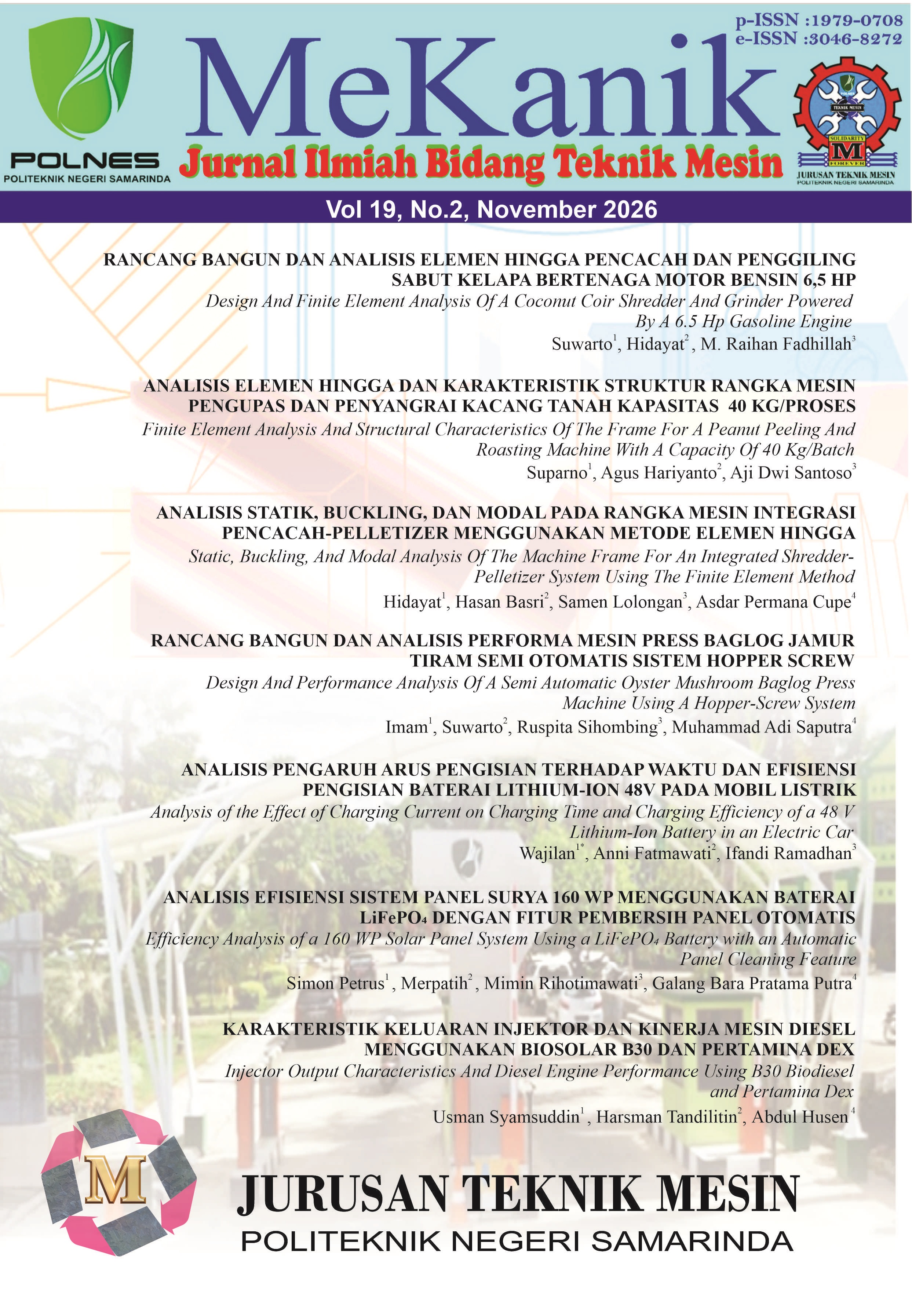
ANALISIS ELEMEN HINGGA DAN KARAKTERISTIK STRUKTUR RANGKA MESIN PENGUPAS DAN PENYANGRAI KACANG TANAH KAPASITAS 40 KG/PROSES
Finite Element Analysis And Structural Characteristics Of The Frame For A Peanut Peeling And Roasting Machine With A Capacity Of 40 Kg/Batch
DOI:
https://doi.org/10.46964/9838xp98Keywords:
Analisis elemen hingga, Kacang tanah, Mesin pengupas, Penyangraian, Rangka MesinAbstract
Pengolahan kacang tanah skala usaha kecil membutuhkan mesin yang mengintegrasikan pengupasan dan penyangraian. Penelitian ini bertujuan merancang mesin pengupas dan penyangrai kacang tanah berkapasitas rencana 40 kg per proses serta menganalisis kekuatan komponennya. Mesin menggunakan motor listrik, transmisi pulley dan sabuk-V untuk unit pengupas, blower pemisah kulit, serta gearbox dan transmisi sproket-rantai untuk memutar drum penyangrai berbahan bakar kompor gas. Analisis elemen hingga dilakukan menggunakan ANSYS Workbench dengan geometri dari Autodesk Inventor 2023. Simulasi statik rangka menghasilkan tegangan von Mises maksimum 16,187 MPa dan deformasi 0,17139 mm, dengan faktor keamanan sekitar 15. Analisis tekuk menghasilkan load multiplier 371,85, sedangkan enam frekuensi natural rangka berada pada rentang 29,061–95,807 Hz. Analisis balok menunjukkan gaya geser maksimum 42,57 N, momen lentur 17.156 N·mm, dan defleksi 0,11805 mm. Tegangan von Mises maksimum poros sebesar 0,17621 MPa. Hasil ini menunjukkan komponen yang dianalisis mampu menahan pembebanan simulasi, tetapi potensi resonansi selama operasi tetap perlu diperhatikan
References
[1] X. Liao et al., “Peanut-Shelling Technologies and Equipment: A Review of Recent Developments,” Agriculture, vol. 14, no. 7, p. 1178, Jul. 2024, doi: 10.3390/agriculture14071178.
[2] S. Ma et al., “Peanut oils from roasting operations: An overview of production technologies, flavor compounds, formation mechanisms, and affecting factors,” Heliyon, vol. 10, no. 15, p. e34678, Aug. 2024, doi: 10.1016/j.heliyon.2024.e34678.
[3] Y. Zhang et al., “Effect of Boiling and Roasting Treatments on the Nutrients, Lipid Quality, and Flavor of Peanuts,” Food Sci. Nutr., vol. 12, no. 11, pp. 9314–9324, Nov. 2024, doi: 10.1002/fsn3.4509.
[4] A. I. Muhammad, M. Isiaka, M. L. Attanda, S. K. Shittu, I. Lawan, and M. I. Bomoi, “Performance Optimization of Groundnut Shelling Using Response Surface Methodology,” Acta Technol. Agric., vol. 24, no. 1, pp. 1–7, Mar. 2021, doi: 10.2478/ata-2021-0001.
[5] A. Pachanawan, K. Doungpoueng, P. Muenkaew, K. Rayanasuk, and M. Srila, “Design and performance evaluation of a propeller-based peanut sheller: efficiency and Economic Feasibility Analysis,” Eng. J., vol. 29, no. 10, p. 15, Oct. 2025, doi: 10.4186/ej.2025.29.10.15.
[6] J. Wang et al., “Mediation of Peanut Moisture Content and System Optimization for Improved Shelling Performance of Small Peanut Sheller,” J. ASABE, vol. 65, no. 2, pp. 295–304, 2022, doi: 10.13031/ja.14742.
[7] J. Wang et al., “Optimization of Material for Key Components and Parameters of Peanut Sheller Based on Hertz Theory and Box–Behnken Design,” Agriculture, vol. 12, no. 2, p. 146, Jan. 2022, doi: 10.3390/agriculture12020146.
[8] C. Xu, A. Zhu, Y. Liu, and S. Shang, “Design and Parameters Optimization of Key Components of Seed Peanut Shelling Test Bench Based on Cohesive Model,” Agriculture, vol. 14, no. 12, p. 2248, Dec. 2024, doi: 10.3390/agriculture14122248.
[9] X. Liao et al., “Optimization of a Low-Loss Peanut Mechanized Shelling Technology Based on Moisture Content, Flexible Materials, and Key Operating Parameters,” Agriculture, vol. 15, no. 22, p. 2365, Nov. 2025, doi: 10.3390/agriculture15222365.
[10] Y. Tuo et al., “Mechanism-constrained D-optimal design of a flexible claw for peanut shelling under biological variability,” Front. Plant Sci., vol. 17, Aug. 2026, doi: 10.3389/fpls.2026.1831721.
[11] T. Xu, X. Tang, Y. Yu, X. Jiang, and C. Li, “Establishment of a Breakable Layered Bonding Model for Peanut Pods Based on DEM and Research on the Shelling Process,” Agriculture, vol. 16, no. 4, p. 440, Feb. 2026, doi: 10.3390/agriculture16040440.
[12] L. Wei, P. Li, Y. Liu, and Y. Xie, “Effects of Drying Methods, Temperature, and Initial Moisture Content on Drying Characteristics, Nutritional Quality, Texture, and Oxidative Stability of Peanuts,” Foods, vol. 15, no. 7, p. 1248, Apr. 2026, doi: 10.3390/foods15071248.
[13] P. Chen et al., “Simulation of heat and mass transfer of peanut pods in combined hot air–radio frequency,” Dry. Technol., vol. 43, no. 4, pp. 639–652, Mar. 2025, doi: 10.1080/07373937.2024.2447051.
[14] D. Zhang, D. Shen, Y. Cao, X. Duan, and H. Sun, “Widely targeted metabolomic approach reveals dynamic changes in non-volatile and volatile metabolites of peanuts during roasting,” Food Chem., vol. 412, p. 135577, Jun. 2023, doi: 10.1016/j.foodchem.2023.135577.
[15] R. de Freitas Floriano, K. Gräbin, R. C. Rossi, C. D. Ferreira, and V. Ziegler, “Impact of roasting conditions on the quality and acceptance of the peanut paste,” J. Texture Stud., vol. 51, no. 5, pp. 841–848, Oct. 2020, doi: 10.1111/jtxs.12541.
[16] R. Golani, C. Leishangthem, H. Xiao, Q. Zhang, and P. P. Sutar, “Effect of high temperature short time infrared roasting of peanuts,” J. Futur. Foods, vol. 4, no. 2, pp. 173–178, Jun. 2024, doi: 10.1016/j.jfutfo.2023.06.009.
[17] R. Hou et al., “Microwave- and radio frequency-assisted two-step roasting of peanut kernels for enhanced heating efficiency and flavor,” Food Chem. X, vol. 29, p. 102702, Jul. 2025, doi: 10.1016/j.fochx.2025.102702.
[18] Z. Peng et al., “Radio frequency roasting promotes the degradation of aflatoxin B1 and achieves better quality of peanuts (Arachis hypogaea L.),” Food Control, vol. 158, p. 110232, Apr. 2024, doi: 10.1016/j.foodcont.2023.110232.
[19] J. Yu, X. Yu, L. Shi, and W. Liu, “Comprehensive Analyses of Advanced Glycation end Products and Heterocyclic Amines in Peanuts during the Roasting Process,” Molecules, vol. 28, no. 20, p. 7012, Oct. 2023, doi: 10.3390/molecules28207012.
[20] A. Agyei-Agyemang, M. K. Commeh, P. O. Tawiah, and B. A. Asaaga, “Numerical Modeling of a Hot Plate Stove for Peanut Roasting,” J. Eng., vol. 2022, pp. 1–12, Feb. 2022, doi: 10.1155/2022/9523767.
[21] P. Muramulla et al., “Heat transfer studies in a rotating drum containing non-spherical particles,” Powder Technol., vol. 438, p. 119607, Apr. 2024, doi: 10.1016/j.powtec.2024.119607.
[22] J. An et al., “Innovative application of microwave hot air technology in the drying of peanut pods: Drying characteristics and kinetic analysis,” Therm. Sci. Eng. Prog., vol. 65, p. 103925, Sep. 2025, doi: 10.1016/j.tsep.2025.103925.
[23] S. L. M. V. Dobrovolsky, K. Zablonsky, S. Mak (COBISS menulis V. A. Dobrovol’skij, K. I. Zablonskij, Machine Elements: A Textbook. 1989.
Downloads
Published
Issue
Section
License
Copyright (c) 2026 Mekanik: Jurnal Ilmiah Bidang Teknik Mesin

This work is licensed under a Creative Commons Attribution-ShareAlike 4.0 International License.