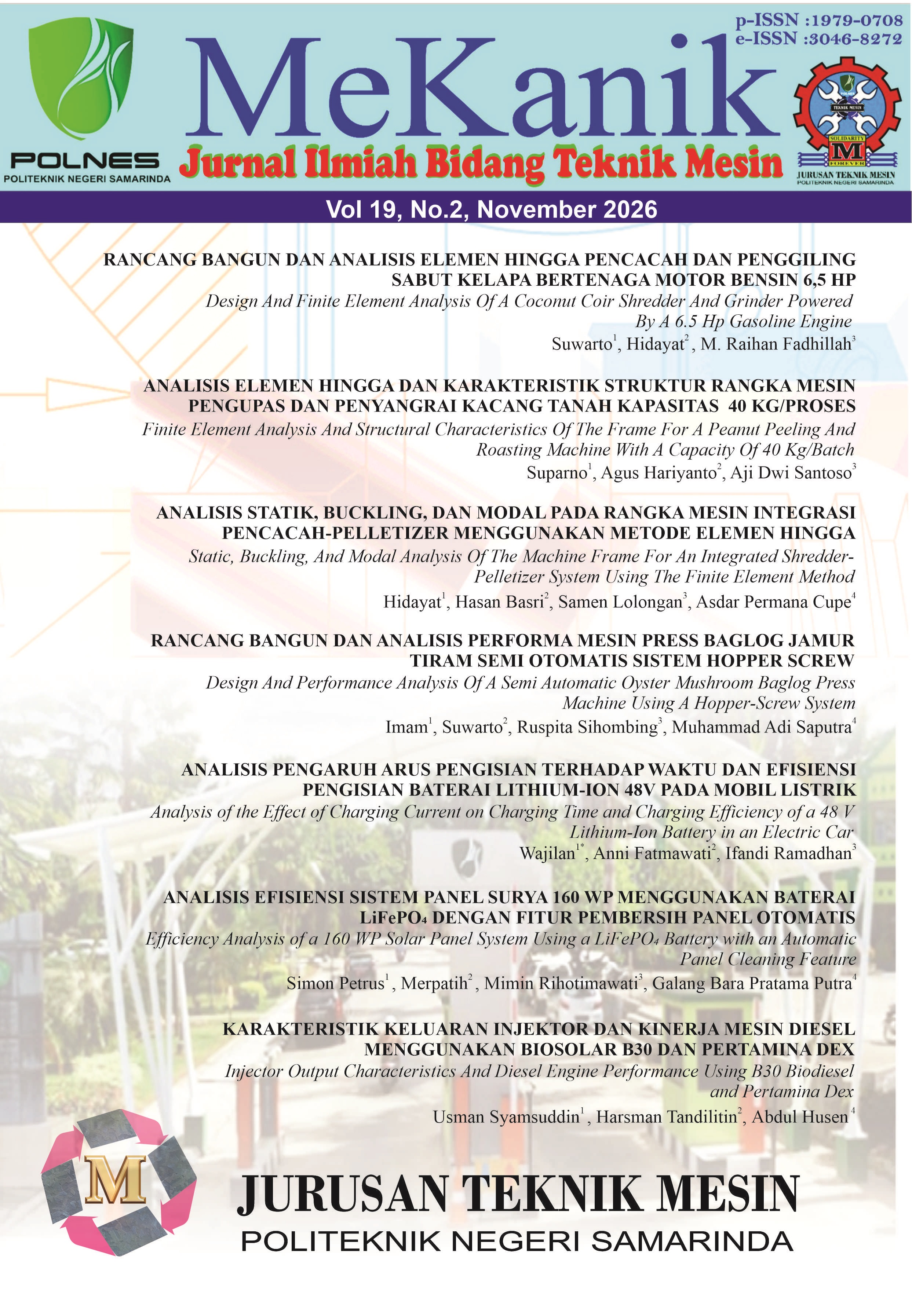
RANCANG BANGUN DAN ANALISIS PERFORMA MESIN PRESS BAGLOG JAMUR TIRAM SEMI OTOMATIS SISTEM HOPPER SCREW
Design And Performance Analysis Of A Semi Automatic Oyster Mushroom Baglog Press Machine Using A Hopper-Screw System
DOI:
https://doi.org/10.46964/exm4fj53Keywords:
Modifikasi mesin, Mesin press baglog, Hopper screw, Jamur tiram, Produktivitas mesinAbstract
Pembuatan baglog jamur tiram secara manual memakan waktu dan menghasilkan kepadatan media yang sulit seragam. Penelitian ini memodifikasi mesin press baglog dengan menambahkan sistem hopper screw agar pengisian dan pemadatan berlangsung semi otomatis. Metode yang dipakai adalah rancang bangun yang mencakup perhitungan elemen mesin, simulasi rangka dengan ANSYS (static structural, buckling, dan modal), serta pengujian kepadatan, produktivitas, dan pertumbuhan miselium. Mesin digerakkan motor 1 HP dengan putaran poros screw 27,4 rpm dan poros press 11 rpm. Rangka menerima tegangan von Mises maksimum 24,431 MPa dengan faktor keamanan sekitar 9,8, beban kritis tekuk 19.029 N, dan frekuensi natural 5,46 sampai 56,46 Hz. Mesin mencapai produktivitas 120 baglog per jam, sedangkan miselium tumbuh paling baik pada baglog berkepadatan normal (0,418 g/cm³). Perhitungan pasak dan poros press menunjukkan perlunya peninjauan ulang sebelum mesin dipakai pada beban kerja penuh. Hasil ini dapat menjadi dasar pengembangan mesin press baglog bagi pelaku usaha jamur skala kecil
References
[1] H. Gebru, T. Belete, and G. Faye, “Growth and Yield Performance of Pleurotus ostreatus Cultivated on Agricultural Residues,” Mycobiology, vol. 52, no. 6, pp. 388–397, Nov. 2024, doi: 10.1080/12298093.2024.2399353.
[2] S. Karpagavalli, R. Manisha, S. Mageshwari, and M. Sowbharnika, “Influence of growth substrates on bioactive compounds and yield of oyster mushroom (Pleurotus florida),” Sci. Hortic. (Amsterdam)., vol. 329, p. 112959, Apr. 2024, doi: 10.1016/j.scienta.2024.112959.
[3] S. I. Zubairi et al., “Pleurotus ostreatus Cultivation: Physico-Chemical Characteristics of a Robust Pre-Blocks Oyster Mushroom Substrate with Absorptive Starch Binders,” Sains Malaysiana, vol. 51, no. 2, pp. 329–343, Feb. 2022, doi: 10.17576/jsm-2022-5102-01.
[4] L. Wiesnerová, T. Hřebečková, I. Jablonský, and M. Koudela, “Effect of different water contents in the substrate on cultivation of Pleurotus ostreatus Jacq. P. Kumm,” Folia Hortic., vol. 35, no. 1, pp. 25–31, Jun. 2023, doi: 10.2478/fhort-2023-0002.
[5] K. A. Schoder, J. Krümpel, J. Müller, and A. Lemmer, “Effects of Environmental and Nutritional Conditions on Mycelium Growth of Three Basidiomycota,” Mycobiology, vol. 52, no. 2, pp. 124–134, Mar. 2024, doi: 10.1080/12298093.2024.2341492.
[6] J. A. Magaña Amaya and N. Shimizu, “Digital Analysis of Mycelium Growth and Mycelium Density In Vitro of Pleurotus ostreatus with Submerged Fermentation as Substrate Treatment,” Mycobiology, vol. 53, no. 2, pp. 214–224, Mar. 2025, doi: 10.1080/12298093.2025.2460291.
[7] E. Salifu, G. Di Rauso Simeone, G. Russo, M. A. Rao, G. Urciuoli, and G. El Mountassir, “Influence of environmental conditions on the growth of Pleurotus ostreatus in sand,” Biogeotechnics, vol. 3, no. 2, p. 100137, Jun. 2025, doi: 10.1016/j.bgtech.2024.100137.
[8] C. Tang et al., “Alkali densification pretreatment of lignocellulose for improving the production of Pleurotus ostreatus,” Food Biosci., vol. 73, p. 107581, Nov. 2025, doi: 10.1016/j.fbio.2025.107581.
[9] Y. Tan, M. Rackl, W. Yang, J. Fottner, W. Meng, and S. Kessler, “A comparative study on design standards of screw conveyors in China, Germany and the USA — Part I: Theoretical calculation and quantitative analysis,” Particuology, vol. 69, pp. 61–76, Oct. 2022, doi: 10.1016/j.partic.2021.11.011.
[10] A. Hamed, Y. Xia, N. Saha, J. Klinger, D. N. Lanning, and J. H. Dooley, “Particle size and shape effect of Crumbler® rotary shear-milled granular woody biomass on the performance of Acrison® screw feeder: A computational and experimental investigation,” Powder Technol., vol. 427, p. 118707, Sep. 2023, doi: 10.1016/j.powtec.2023.118707.
[11] N. Saha, C. Goates, S. Hernandez, W. Jin, T. Westover, and J. Klinger, “Characterization of particle size and moisture content effects on mechanical and feeding behavior of milled corn (Zea mays L.) stover,” Powder Technol., vol. 405, p. 117535, Jun. 2022, doi: 10.1016/j.powtec.2022.117535.
[12] Y. Lu, W. Jin, J. L. Klinger, and S. Dai, “Effects of the Moisture Content on the Flow Behavior of Milled Woody Biomass,” ACS Sustain. Chem. Eng., vol. 11, no. 31, pp. 11482–11489, Aug. 2023, doi: 10.1021/acssuschemeng.3c01344.
[13] F. Chen, Y. Xia, J. Klinger, and Q. Chen, “Hopper discharge flow dynamics of milled pine and prediction of process upsets using the discrete element method,” Powder Technol., vol. 415, p. 118165, Feb. 2023, doi: 10.1016/j.powtec.2022.118165.
[14] G. Lian, W. Zhong, and X. Liu, “DEM study on the mixed feeding process of coal and cylindroid biomass particles in a screw feeder,” Adv. Powder Technol., vol. 32, no. 7, pp. 2543–2554, Jul. 2021, doi: 10.1016/j.apt.2021.05.031.
[15] X. Mei, Y. Xue, and L. Zhang, “Determination of the optimal working performance matching through theoretical analysis and experimental study for a screw conveyor,” PLoS One, vol. 17, no. 6, p. e0266948, Jun. 2022, doi: 10.1371/journal.pone.0266948.
[16] P. Chen et al., “Modeling the Discharge Rate of a Screw Conveyor Considering Hopper–Conveyor Coupling Parameters,” Agriculture, vol. 14, no. 7, p. 1203, Jul. 2024, doi: 10.3390/agriculture14071203.
[17] Y. Zhao et al., “SPH Modeling of Biomass Granular Flow: Engineering Application in Hoppers and Augers,” ACS Sustain. Chem. Eng., vol. 12, no. 10, pp. 4213–4223, Mar. 2024, doi: 10.1021/acssuschemeng.3c08090.
[18] Y. Zhao, W. Jin, J. Klinger, D. C. Dayton, and S. Dai, “SPH modeling of biomass granular flow: Theoretical implementation and experimental validation,” Powder Technol., vol. 426, p. 118625, Aug. 2023, doi: 10.1016/j.powtec.2023.118625.
[19] Z. Ma et al., “Study of the grain particle-conveying performance of a bionic non-smooth-structure screw conveyor,” Biosyst. Eng., vol. 238, pp. 94–104, Feb. 2024, doi: 10.1016/j.biosystemseng.2024.01.005.
[20] E. Aschenbrenner and A. Funke, “Numerical Validation of a Screw Conveyor Design Method,” Energy & Fuels, vol. 38, no. 14, pp. 13019–13028, Jul. 2024, doi: 10.1021/acs.energyfuels.4c00189.
[21] L. Mahto et al., “Accelerated DEM simulation of the hopper-screw feeder and tablet-press feeder using the multi-level coarse-graining technique,” Powder Technol., vol. 436, p. 119466, Mar. 2024, doi: 10.1016/j.powtec.2024.119466.
[22] B. M. Kerins, M. O’Mahony, and A. M. Crean, “Study of the feeding performance of mesoporous silica in a loss-in-weight feeder,” Powder Technol., vol. 424, p. 118529, Jun. 2023, doi: 10.1016/j.powtec.2023.118529.
[23] T. Rizaldi, Raju, and M. R. Piliang, “Design of filler and compactor for oyster mushroom growing medium (baglog),” IOP Conf. Ser. Earth Environ. Sci., vol. 260, no. 1, p. 012031, May 2019, doi: 10.1088/1755-1315/260/1/012031.
Downloads
Published
Issue
Section
License
Copyright (c) 2026 Mekanik: Jurnal Ilmiah Bidang Teknik Mesin

This work is licensed under a Creative Commons Attribution-ShareAlike 4.0 International License.