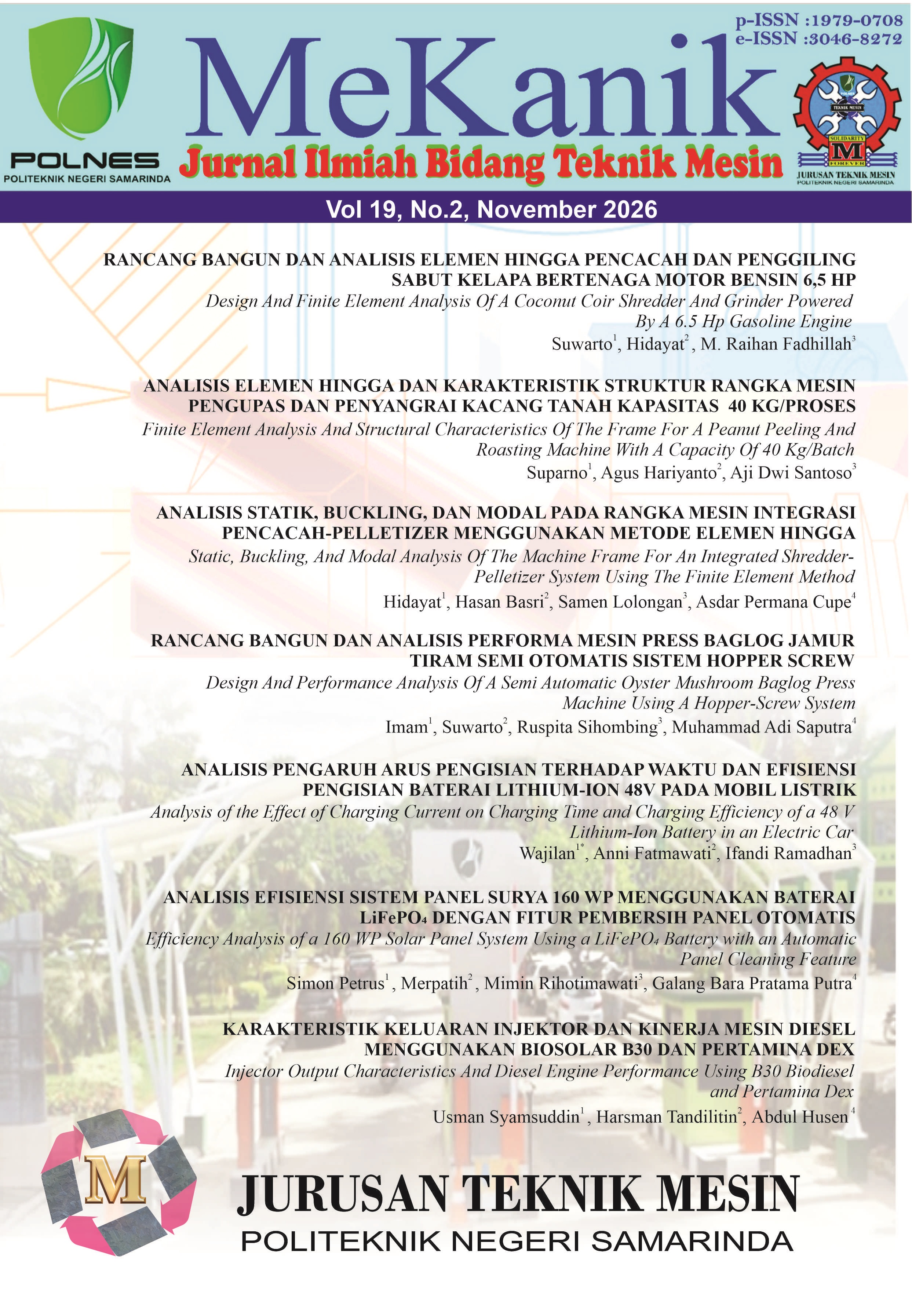
ANALISIS PENGARUH ARUS PENGISIAN TERHADAP WAKTU DAN EFISIENSI PENGISIAN BATERAI LITHIUM-ION 48V PADA MOBIL LISTRIK
Analysis of the Effect of Charging Current on Charging Time and Charging Efficiency of a 48 V Lithium-Ion Battery in an Electric Car
DOI:
https://doi.org/10.46964/hgzznq08Keywords:
Arus Pengisian, Baterai Lithium-Ion, Durasi Pengisian, Efisiensi Energi, SuhuAbstract
Penelitian ini bertujuan menganalisis pengaruh variasi arus pengisian terhadap durasi pengisian, peningkatan suhu, dan efisiensi energi pada baterai lithium-ion 48 V 45 Ah. Metode yang digunakan adalah analisis kuantitatif dengan tiga variasi arus, yaitu 4,5 A (0,1C), 9 A (0,2C), dan 13,5 A (0,3C), menggunakan metode pengisian Constant Current-Constant Voltage (CC-CV). Hasil analisis menunjukkan bahwa peningkatan arus memperpendek durasi ideal pengisian hingga State of Charge (SOC) 80%, dari 8 jam pada arus 4,5 A menjadi 4 jam pada arus 9 A dan 2,67 jam pada arus 13,5 A. Namun, peningkatan arus juga menaikkan potensi rugi panas resistif dengan indeks laju panas relatif sebesar 1, 4, dan 9. Hubungan antara arus dan efisiensi energi tidak bersifat linier. Arus rendah meningkatkan rugi tetap akibat durasi yang panjang, sedangkan arus tinggi meningkatkan rugi konduksi dan panas. Berdasarkan kompromi antara durasi dan beban termal, arus 9 A dinilai sebagai pilihan awal yang moderat dengan tetap mengikuti batas aman baterai, charger, dan BMS.
References
[1] M. T. Shahed and A. B. M. H. Rashid, “Battery charging technologies and standards for electric vehicles: A state-of-the-art review, challenges, and future research prospects,” Energy Reports, vol. 11, pp. 5978–5998, Jun. 2024, doi: 10.1016/j.egyr.2024.05.062.
[2] S. Li, J. Ma, X. Zhao, K. Zhang, Z. Jiao, and Q. Xue, “Towards intelligent electric vehicle power batteries and multi-scenario application vehicle operation safety charging strategies: a review,” Sustain. Energy Fuels, vol. 8, no. 16, pp. 3496–3523, 2024, doi: 10.1039/D4SE00291A.
[3] H. Zhou et al., “Effect of fast charging on degradation and safety characteristics of lithium-ion batteries with LiFePO4 cathodes,” Appl. Energy, vol. 377, p. 124465, Jan. 2025, doi: 10.1016/j.apenergy.2024.124465.
[4] R. Xiong, P. Wang, Y. Jia, W. Shen, and F. Sun, “Multi-factor aging in Lithium Iron phosphate batteries: Mechanisms and insights,” Appl. Energy, vol. 382, p. 125250, Mar. 2025, doi: 10.1016/j.apenergy.2024.125250.
[5] J. G. Qu, Z. Y. Jiang, and J. F. Zhang, “Investigation on lithium-ion battery degradation induced by combined effect of current rate and operating temperature during fast charging,” J. Energy Storage, vol. 52, p. 104811, Aug. 2022, doi: 10.1016/j.est.2022.104811.
[6] Z. Wang, X. Wu, Z. Bai, N. Yang, G. Guo, and O. S. Banjoko, “Enhancing fast charging performance of lithium-ion batteries: The role of operating temperature and charging rate,” Electrochim. Acta, vol. 511, p. 145390, Jan. 2025, doi: 10.1016/j.electacta.2024.145390.
[7] M. Usman Tahir, A. Sangwongwanich, D.-I. Stroe, and F. Blaabjerg, “Overview of multi-stage charging strategies for Li-ion batteries,” J. Energy Chem., vol. 84, pp. 228–241, Sep. 2023, doi: 10.1016/j.jechem.2023.05.023.
[8] Q.-Y. Huang, Y.-H. Liu, G.-J. Chen, Y.-F. Luo, and C.-L. Liu, “Optimization of the SOC-based multi-stage constant current charging strategy using coyote optimization algorithm,” J. Energy Storage, vol. 77, p. 109867, Jan. 2024, doi: 10.1016/j.est.2023.109867.
[9] M. Zhiani, M. Moslemi, M. Jamali, and H. Gharibi, “Impact of fast-charging protocols and state-of-charge windows on the performance and cycle life of commercial lithium-ion batteries,” J. Power Sources, vol. 678, p. 239975, Jun. 2026, doi: 10.1016/j.jpowsour.2026.239975.
[10] A. Laforgue et al., “Comparative investigation of the impact of fast charging at low temperature on commercial Li-ion cells,” J. Power Sources, vol. 524, p. 231071, Mar. 2022, doi: 10.1016/j.jpowsour.2022.231071.
[11] R. Kim, Y. Kim, D. H. Lee, S. Kim, and D. K. Kim, “Thermal–electrochemical effect on the degradation of lithium-ion batteries during the charging process,” Int. Commun. Heat Mass Transf., vol. 158, p. 107855, Nov. 2024, doi: 10.1016/j.icheatmasstransfer.2024.107855.
[12] W. Wang, Y. Wang, R. Ni, and Z. Xie, “Effects of Fast Charging Modes on Thermal Performance of Lithium‐Ion Battery,” Energy Technol., vol. 10, no. 11, Nov. 2022, doi: 10.1002/ente.202200415.
[13] D. Meng, X. Wang, W. Hu, C. Zhao, and J. Wang, “Experimental investigation of aging effects on thermal behavior of lithium-ion batteries during charging process,” J. Energy Storage, vol. 98, p. 113102, Sep. 2024, doi: 10.1016/j.est.2024.113102.
[14] M. Scheller, A. Aufschläger, A. Frank, M. Steinhardt, J. Sturm, and A. Jossen, “Experimental Investigation on the Impact of Various Cooling Conditions for Fast Charging Cylindrical Lithium-ion Cells,” J. Energy Storage, vol. 56, p. 105942, Dec. 2022, doi: 10.1016/j.est.2022.105942.
[15] A. Khan et al., “A state-of-the-art review on heating and cooling of lithium-ion batteries for electric vehicles,” J. Energy Storage, vol. 76, p. 109852, Jan. 2024, doi: 10.1016/j.est.2023.109852.
[16] F. S. Hwang et al., “Review of battery thermal management systems in electric vehicles,” Renew. Sustain. Energy Rev., vol. 192, p. 114171, Mar. 2024, doi: 10.1016/j.rser.2023.114171.
[17] S. Sarkar, M. T. Amin, M. M. El-Halwagi, and F. Khan, “Thermal behavior of LiFePO4 battery at faster C-rates and lower ambient temperatures,” Process Saf. Environ. Prot., vol. 186, pp. 118–133, Jun. 2024, doi: 10.1016/j.psep.2024.03.095.
[18] J. Liu, L. Zhou, H. Zhang, K. Zhao, and Z. Wang, “Aging and thermal behavior of lithium-ion battery under high charging current cycling,” Therm. Sci. Eng. Prog., vol. 69, p. 104466, Jan. 2026, doi: 10.1016/j.tsep.2025.104466.
[19] K. Wang, D. Wu, C. Chang, J. Zhang, D. Ouyang, and X. Qian, “Charging rate effect on overcharge-induced thermal runaway characteristics and gas venting behaviors for commercial lithium iron phosphate batteries,” J. Clean. Prod., vol. 434, p. 139992, Jan. 2024, doi: 10.1016/j.jclepro.2023.139992.
[20] M. Jiao et al., “Balancing Charging Efficiency and Thermal Safety: A Comparative Analysis of Multistage Constant Current Charging Protocols,” Ind. Eng. Chem. Res., vol. 63, no. 22, pp. 10054–10066, Jun. 2024, doi: 10.1021/acs.iecr.4c00971.
[21] J. Liu and X. Wang, “Experimental study of the effect of different pulse charging patterns on lithium-ion battery charging,” J. Power Sources, vol. 610, p. 234700, Aug. 2024, doi: 10.1016/j.jpowsour.2024.234700.
[22] B. Zhou et al., “Life-extending optimal charging for lithium-ion batteries based on a multi-physics model and model predictive control,” Appl. Energy, vol. 361, p. 122918, May 2024, doi: 10.1016/j.apenergy.2024.122918.
[23] X. Su, B. Sun, J. Wang, H. Ruan, W. Zhang, and Y. Bao, “Experimental study on charging energy efficiency of lithium-ion battery under different charging stress,” J. Energy Storage, vol. 68, p. 107793, Sep. 2023, doi: 10.1016/j.est.2023.107793.
[24] N. Blasuttigh, H. Beiranvand, T. Pereira, S. Castellan, A. M. Pavan, and M. Liserre, “Charging Strategy for Lithium-Ion Batteries: Theory, Design, and Validation,” IEEE Trans. Power Electron., vol. 39, no. 7, pp. 7890–7900, Jul. 2024, doi: 10.1109/TPEL.2024.3381644.
[25] Y. Kim, “Critical Review of Optimal Control Methods for Li‐Ion Batteries in Electric Vehicles,” ChemElectroChem, vol. 11, no. 3, Feb. 2024, doi: 10.1002/celc.202300497.
[26] H. Nazlıgül, M. M. Savrun, and B. Doğru Mert, “Extreme weather impacts on LiFePO4 batteries: Insights from arrhenius-based analysis and charging techniques,” J. Energy Storage, vol. 144, p. 119820, Jan. 2026, doi: 10.1016/j.est.2025.119820.
[27] C. Zhang, J. Jiang, Y. Gao, W. Zhang, Q. Liu, and X. Hu, “Charging optimization in lithium-ion batteries based on temperature rise and charge time,” Appl. Energy, vol. 194, pp. 569–577, May 2017, doi: 10.1016/j.apenergy.2016.10.059.
[28] Y. Liu, L. Zhang, J. Jiang, S. Wei, S. Liu, and W. Zhang, “A Data-Driven Learning-Based Continuous-Time Estimation and Simulation Method for Energy Efficiency and Coulombic Efficiency of Lithium Ion Batteries,” Energies, vol. 10, no. 5, p. 597, Apr. 2017, doi: 10.3390/en10050597.
[29] P. Keil and A. Jossen, “Charging protocols for lithium-ion batteries and their impact on cycle life—An experimental study with different 18650 high-power cells,” J. Energy Storage, vol. 6, pp. 125–141, May 2016, doi: 10.1016/j.est.2016.02.005.
[30] D. Bernardi, E. Pawlikowski, and J. Newman, “A General Energy Balance for Battery Systems,” J. Electrochem. Soc., vol. 132, no. 1, pp. 5–12, Jan. 1985, doi: 10.1149/1.2113792.
Downloads
Published
Issue
Section
License
Copyright (c) 2026 Mekanik: Jurnal Ilmiah Bidang Teknik Mesin

This work is licensed under a Creative Commons Attribution-ShareAlike 4.0 International License.