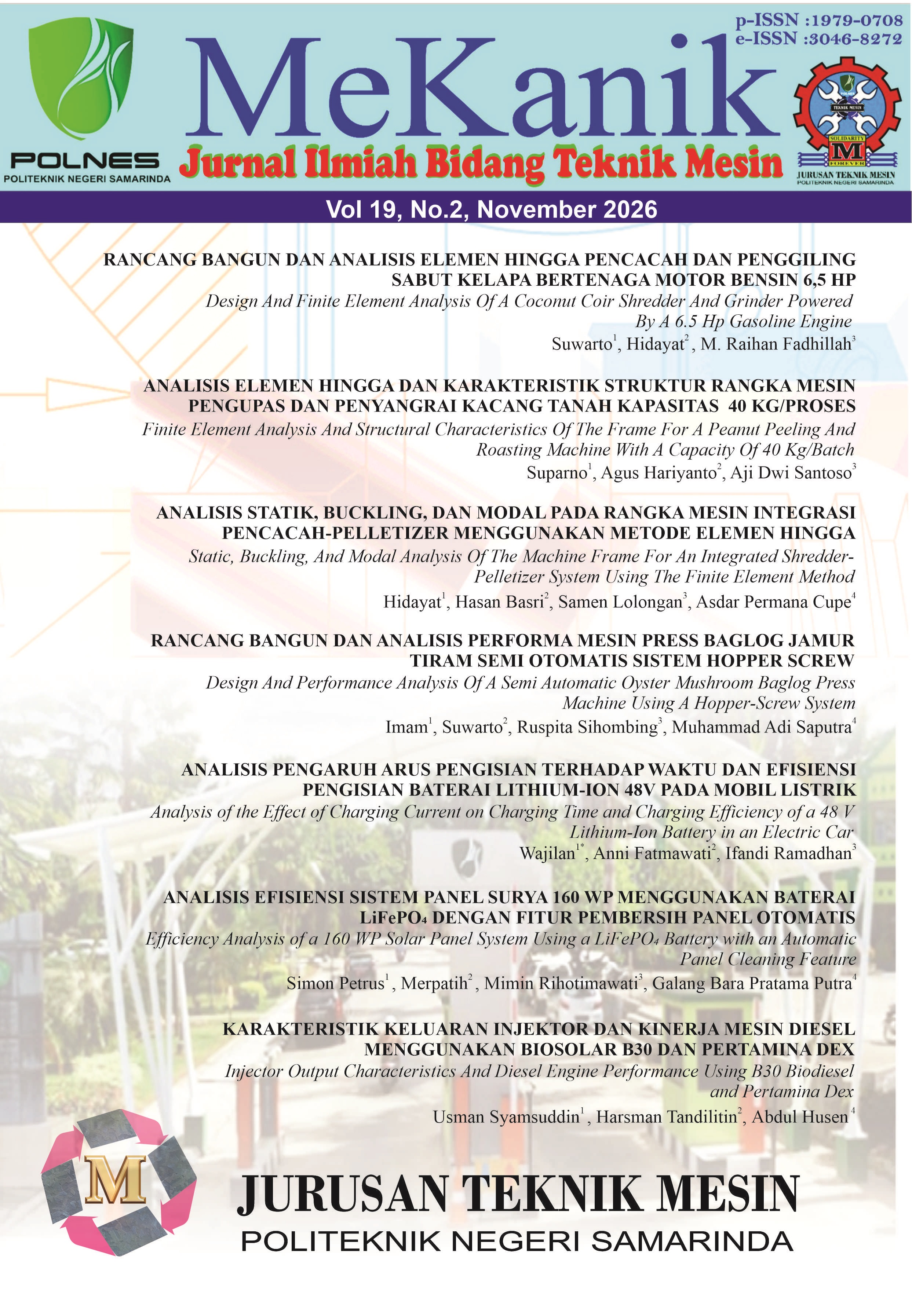
ANALISIS EFISIENSI SISTEM PANEL SURYA 160 WP MENGGUNAKAN BATERAI LiFePO₄ DENGAN FITUR PEMBERSIH PANEL OTOMATIS
Efficiency Analysis of a 160 WP Solar Panel System Using a LiFePO₄ Battery with an Automatic Panel Cleaning Feature
DOI:
https://doi.org/10.46964/k08t9x40Keywords:
Panel surya 160 Wp, baterai LiFePO₄, pembersih panel otomatis, efisiensi PLTS, daya keluaranAbstract
Debu yang menempel pada permukaan panel dan penyimpan energi yang boros sama-sama menggerus kinerja Pembangkit Listrik Tenaga Surya (PLTS). Penelitian ini menguji sistem panel surya monocrystalline 160 Wp dengan baterai Lithium Iron Phosphate (LiFePO₄) rakitan 12,8 V 100 Ah dan pembersih panel otomatis di SMK Diponegoro Samboja, Kalimantan Timur. Tegangan dan arus dicatat setiap jam pukul 09.00 hingga 16.00 WITA pada tiga kondisi, yaitu debu tipis, debu tebal, dan panel setelah dibersihkan. Daya keluaran panel bersih mencapai 47,81 W, dibandingkan 28,26 W pada debu tipis dan 24,91 W pada debu tebal, atau naik 69,18% dan 91,93%. Efisiensi hasil hitung berturut-turut 6,05%, 3,58%, dan 3,15% dengan iradiasi diasumsikan 1000 W/m². Tegangan baterai LiFePO₄ turun 0,21 V selama 180 menit pengosongan, sedangkan data pembanding VRLA 65 Ah turun 0,74 V. Energi efektif baterai 960 Wh menyisakan 359,57 Wh setelah beban lampu 50 W selama 12 jam dan dua siklus pembersihan
References
[1] H. Abdulla, A. Sleptchenko, and A. Nayfeh, “Photovoltaic systems operation and maintenance : A review and future directions,” Renew. Sustain. Energy Rev., vol. 195, no. December 2023, p. 114342, 2024, doi: 10.1016/j.rser.2024.114342.
[2] A. Parsay et al., “Enhancing photovoltaic efficiency: An in-depth systematic review and critical analysis of dust monitoring, mitigation, and cleaning techniques,” Appl. Energy, vol. 388, p. 125668, Jun. 2025, doi: 10.1016/j.apenergy.2025.125668.
[3] T. Alkharusi, M. M. Alzahrani, C. Pandey, H. Yildizhan, and C. N. Markides, “Experimental investigation of nonuniform PV soiling,” Sol. Energy, vol. 272, p. 112493, Apr. 2024, doi: 10.1016/j.solener.2024.112493.
[4] L. Micheli, E. F. Fernández, Á. Fernández‐Solas, J. G. Bessa, and F. Almonacid, “Analysis and mitigation of nonuniform soiling distribution on utility‐scale photovoltaic systems,” Prog. Photovoltaics Res. Appl., vol. 30, no. 3, pp. 211–228, Mar. 2022, doi: 10.1002/pip.3477.
[5] Á. Fernández-Solas, J. Montes-Romero, L. Micheli, F. Almonacid, and E. F. Fernández, “Estimation of soiling losses in photovoltaic modules of different technologies through analytical methods,” Energy, vol. 244, p. 123173, Apr. 2022, doi: 10.1016/j.energy.2022.123173.
[6] J. Agbogla, C. K. K. Sekyere, F. K. Forson, R. Opoku, and B. Baah, “Soiling estimation methods in solar photovoltaic systems: Review, challenges and future directions,” Results Eng., vol. 26, p. 104810, Jun. 2025, doi: 10.1016/j.rineng.2025.104810.
[7] Y. Liu et al., “Solar photovoltaic panel soiling accumulation and removal methods: A review,” IET Renew. Power Gener., vol. 18, no. 16, pp. 4097–4118, Dec. 2024, doi: 10.1049/rpg2.12940.
[8] M. Gandomzadeh et al., “Dust mitigation methods and multi-criteria decision-making cleaning strategies for photovoltaic systems: Advances, challenges, and future directions,” Energy Strateg. Rev., vol. 57, p. 101629, Jan. 2025, doi: 10.1016/j.esr.2024.101629.
[9] N. Shahzad, N. Hussain, S. Umar, M. F. Azam, T. Yousaf, and A. Waqas, “Impacts of soiling on solar panel performance and state-of-the-art effective cleaning methods: A recent review,” J. Clean. Prod., vol. 497, p. 145119, Mar. 2025, doi: 10.1016/j.jclepro.2025.145119.
[10] S. Umar et al., “A building integrated solar PV surface-cleaning setup to optimize the electricity output of PV modules in a polluted atmosphere,” Renew. Energy, vol. 216, p. 119122, Nov. 2023, doi: 10.1016/j.renene.2023.119122.
[11] H. A. Kazem, A. H. A. Al-Waeli, M. T. Chaichan, K. Sopian, A. Gholami, and W. E. Alnaser, “Dust and cleaning impact on the performance of photovoltaic: an outdoor experimental study,” Energy Sources, Part A Recover. Util. Environ. Eff., vol. 45, no. 1, pp. 3107–3124, Apr. 2023, doi: 10.1080/15567036.2023.2191064.
[12] W. Tanveer, A. Waqas, S. Umar, N. Shahzad, U. Imtiaz, and S. Shakir, “Economic and performance evaluation of an automated PV cleaning system with water recycling in Islamabad, Pakistan,” Energy Reports, vol. 15, p. 109132, Jun. 2026, doi: 10.1016/j.egyr.2026.109132.
[13] S. Mousavi and G. Farahani, “Introducing a new method of automatic cleaning of the PV array surface using a suction robot,” Mechatronics, vol. 85, p. 102845, Aug. 2022, doi: 10.1016/j.mechatronics.2022.102845.
[14] M. K. Swain, M. Mishra, R. C. Bansal, and S. Hasan, “A Self-Powered Solar Panel Automated Cleaning System: Design and Testing Analysis,” Electr. Power Components Syst., vol. 49, no. 3, pp. 308–320, Feb. 2021, doi: 10.1080/15325008.2021.1937400.
[15] M. Ghafoor, A. A. Amin, and M. S. Khalid, “Design of IoT-based solar array cleaning system with enhanced performance and efficiency,” Meas. Control, vol. 57, no. 8, pp. 1099–1111, Aug. 2024, doi: 10.1177/00202940241233383.
[16] F. Norde Santos et al., “Cleaning of Photovoltaic Modules through Rain: Experimental Study and Modeling Approaches,” Sol. RRL, vol. 8, no. 24, Dec. 2024, doi: 10.1002/solr.202400551.
[17] A. B. Ahmadullah, I. A. Bakhtyal, A. S. Irshad, Z. H. Doost, N. Wali, and B. A. Karimi, “Comparative assessment of optimal cleaning schedules for various PV cleaning techniques,” Renew. Energy, vol. 256, p. 124182, Jan. 2026, doi: 10.1016/j.renene.2025.124182.
[18] M. Wieczorek, S. Wodyk, R. Poliszkiewicz, and P. Witaszek, “The influence of current in off-grid PV systems on lead–acid battery lifetime and hybridization with LFP battery as solution,” Energy Reports, vol. 9, pp. 766–773, Oct. 2023, doi: 10.1016/j.egyr.2023.05.213.
[19] R. Yudhistira, D. Khatiwada, and F. Sanchez, “A comparative life cycle assessment of lithium-ion and lead-acid batteries for grid energy storage,” J. Clean. Prod., vol. 358, p. 131999, Jul. 2022, doi: 10.1016/j.jclepro.2022.131999.
[20] S. Gupta, Y. Sawle, K. Thakre, and M. Thirunavukkarasu, “Techno-economic-environmental analysis of hybrid renewable energy system with lead acid and lithium-ion energy storage under different PV tracking orientations,” J. Energy Storage, vol. 130, p. 117417, Sep. 2025, doi: 10.1016/j.est.2025.117417.
[21] S. Zamani and M. Hamzeh, “The effect of battery charging method on reducing battery capacity in off-grid solar home systems,” Energy Reports, vol. 10, pp. 3418–3426, Nov. 2023, doi: 10.1016/j.egyr.2023.10.026.
[22] M. Shabani, F. Wallin, E. Dahlquist, and J. Yan, “Techno-economic assessment of battery storage integrated into a grid-connected and solar-powered residential building under different battery ageing models,” Appl. Energy, vol. 318, p. 119166, Jul. 2022, doi: 10.1016/j.apenergy.2022.119166.
[23] J. Kang, G. Yang, Y. Wang, J. V. Wang, Q. Wang, and G. Zhu, “Study of aging mechanisms in LiFePO4 batteries with various SOC levels using the zero-sum pulse method,” iScience, vol. 27, no. 7, p. 110287, Jul. 2024, doi: 10.1016/j.isci.2024.110287.
[24] N. Ghaeminezhad, Q. Ouyang, J. Wei, Y. Xue, and Z. Wang, “Review on state of charge estimation techniques of lithium-ion batteries: A control-oriented approach,” J. Energy Storage, vol. 72, p. 108707, Nov. 2023, doi: 10.1016/j.est.2023.108707.
[25] Z. Zhang et al., “State-of-charge and capacity estimation for MWh-scale LiFePO4 peak-shaving battery energy storage stations based on real-world operating data,” Energy, vol. 339, p. 139086, Dec. 2025, doi: 10.1016/j.energy.2025.139086.
[26] Z. J. Zhu, N. Espinosa, and S. M. Jordaan, “Life cycle assessment of solar photovoltaic–battery systems: A Canadian case study,” Sustain. Energy Technol. Assessments, vol. 90, p. 105017, Jun. 2026, doi: 10.1016/j.seta.2026.105017.
[27] T. Sarver, A. Al-Qaraghuli, and L. L. Kazmerski, “A comprehensive review of the impact of dust on the use of solar energy: History, investigations, results, literature, and mitigation approaches,” Renew. Sustain. Energy Rev., vol. 22, pp. 698–733, Jun. 2013, doi: 10.1016/j.rser.2012.12.065.
Downloads
Published
Issue
Section
License
Copyright (c) 2026 Mekanik: Jurnal Ilmiah Bidang Teknik Mesin

This work is licensed under a Creative Commons Attribution-ShareAlike 4.0 International License.