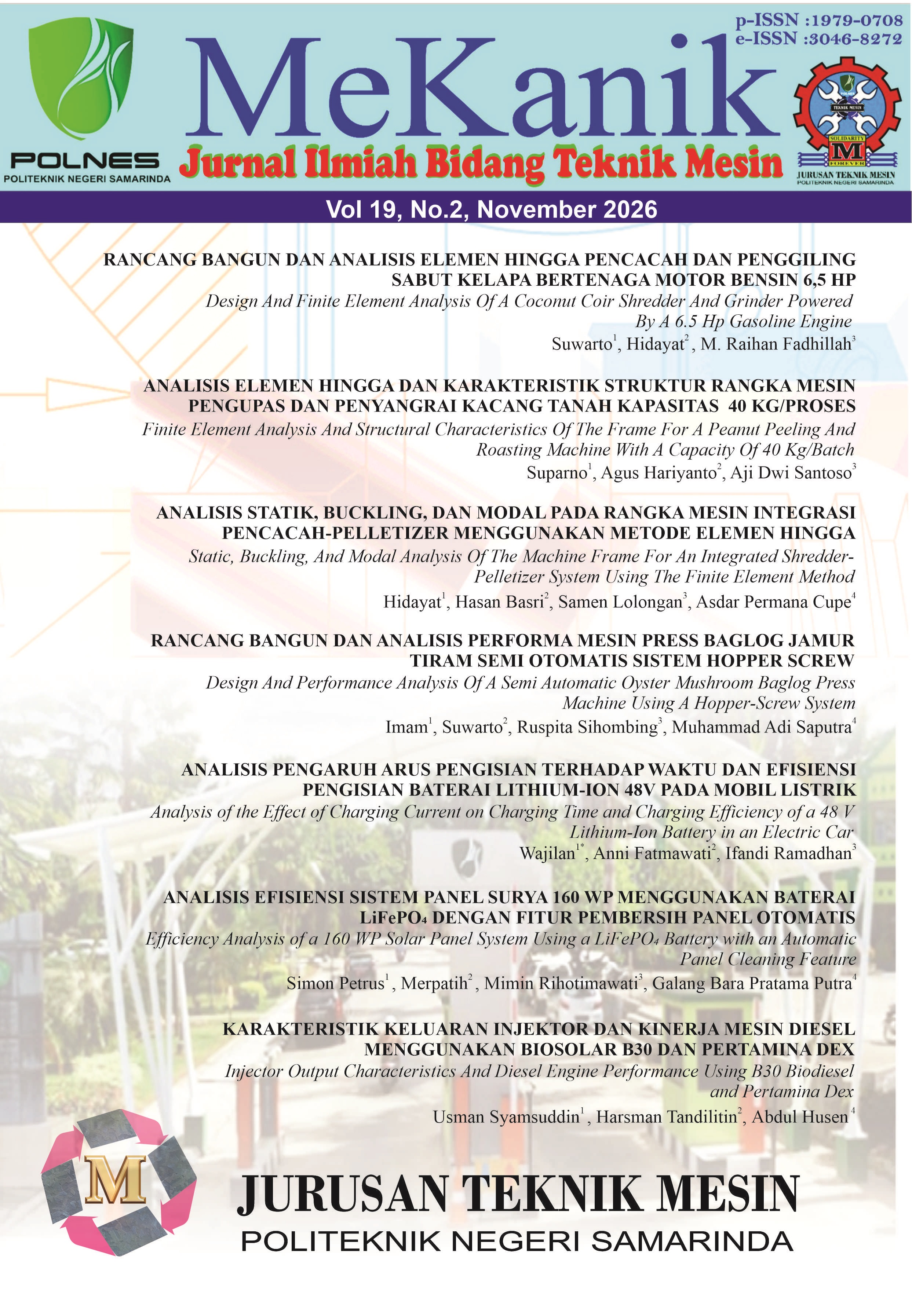
KARAKTERISTIK KELUARAN INJEKTOR DAN KINERJA MESIN DIESEL MENGGUNAKAN BIOSOLAR B30 DAN PERTAMINA DEX
Injector Output Characteristics And Diesel Engine Performance Using B30 Biodiesel and Pertamina Dex
DOI:
https://doi.org/10.46964/nw5psb07Keywords:
Biosolar B30; Pertamina Dex; injektor; volume keluaran; torsi; mesin dieselAbstract
Penelitian ini membandingkan volume keluaran injektor pada Biosolar B30 dan Pertamina Dex serta menelaah data daya mesin diesel pada tiga tingkat putaran. Volume bahan bakar diperoleh dari pengujian injector cleaner and tester dengan setelan tekanan 90, 100, 110, 120, dan 130 psi, tingkat putaran simulasi 1.000, 1.500, dan 2.000 rpm, serta tiga pengulangan selama 60 detik pada setiap kombinasi. Data daya mesin Toyota 2KD-FTV dianalisis secara terpisah. Hasil menunjukkan volume keluaran terendah 12,50 mL pada 90 psi dan 1.000 rpm, sedangkan keluaran tertinggi mencapai 35,00 mL pada 130 psi dan 2.000 rpm untuk kedua bahan bakar. Pada 10 dari 15 kombinasi setelan, rerata volume kedua bahan bakar identik. Data daya yang dilaporkan menunjukkan Pertamina Dex lebih tinggi pada 1.000 rpm (13,39 berbanding 7,89 HP), tetapi B30 lebih tinggi pada 2.000 rpm (43,24 berbanding 35,97 HP). Torsi dihitung ulang dengan hubungan daya dan kecepatan sudut, dengan asumsi satuan HP mekanis. Pengamatan keluaran pada perangkat uji injektor tidak cukup untuk membuktikan efisiensi bahan bakar atau dampak langsung tekanan uji terhadap torsi mesin. Hasil ini memberikan perbandingan deskriptif yang dapat menjadi dasar pengujian lanjutan dengan pengukuran aliran bahan bakar dan daya mesin
References
[1] I. HARYONO, “AN INVESTIGATION OF 30% PALM BIODIESEL BLEND FUEL (B30) UNDER INDONESIAN OPERATING CONDITIONS,” J. Oil Palm Res., Feb. 2024, doi: 10.21894/jopr.2024.0013.
[2] M. Q. Mohd Tamam et al., “Engine performance and emissions evaluation of surfactant-free B30 biodiesel–diesel/water emulsion as alternative fuel,” Sci. Rep., vol. 13, no. 1, p. 10599, Jun. 2023, doi: 10.1038/s41598-023-37662-4.
[3] T. Kristyadi, D. I. Permana, M. P. N. Sirodz, E. Saefudin, and I. Farkas, “Performance and Emission of Diesel Engine Fuelled by Commercial Bio-Diesel Fuels in Indonesia,” Acta Technol. Agric., vol. 25, no. 4, pp. 221–228, Dec. 2022, doi: 10.2478/ata-2022-0032.
[4] N. Cahyo, B. F. T. Tamtomo Kiono, M. S. K. T. S. Utomo, M. A. Rahmanta, and P. Paryanto, “Comparative Assessment of Diesel–Palm-Based Biodiesel and Green Diesel Blends on Engine Performance, Operating Parameters, and Acoustic Emissions in a Compression-Ignition Engine,” Energies, vol. 19, no. 12, p. 2930, Jun. 2026, doi: 10.3390/en19122930.
[5] B. Musthafa and M. Prabhahar, “Numerical and experimental investigation of CI engine parameters using palm biodiesel with diesel blends,” Sci. Rep., vol. 15, no. 1, p. 43399, Dec. 2025, doi: 10.1038/s41598-025-00170-8.
[6] I. S. Mohamed et al., “Optimization of Performance and Emission Characteristics of the CI Engine Fueled with Preheated Palm Oil in Blends with Diesel Fuel,” Sustainability, vol. 14, no. 23, p. 15487, Nov. 2022, doi: 10.3390/su142315487.
[7] F. Kafrawi, K. H. Lee, C. Zhang, and S. Bari, “Spray analysis of Palm-Based biodiesel to correlate performance and combustion analysis of a compression ignition engine,” Fuel, vol. 319, p. 123822, Jul. 2022, doi: 10.1016/j.fuel.2022.123822.
[8] V. D. Chaudhari, V. S. Jagdale, D. Chorey, and D. Deshmukh, “Combustion and spray breakup characteristics of biodiesel for cold start application,” Clean. Eng. Technol., vol. 5, p. 100285, Dec. 2021, doi: 10.1016/j.clet.2021.100285.
[9] T. C. Vo and T. A. Huynh, “Investigation of injection rate characteristics and applicability of palm-biodiesel blending ratios in various diesel injector nozzle geometries under simulated CI engine operating conditions,” Transp. Eng., vol. 21, p. 100378, Sep. 2025, doi: 10.1016/j.treng.2025.100378.
[10] X. Wang et al., “Role of injection pressure on fuel atomization and spray penetration on the Thevetia peruviana and Jatropha curcas biodiesel blends with nanoparticle,” Fuel, vol. 324, p. 124527, Sep. 2022, doi: 10.1016/j.fuel.2022.124527.
[11] M. F. Al-Dawody, K. A. Al-Farhany, N. H. Hamza, and D. A. Hamzah, “Numerical study for the spray characteristics of diesel engine powered by biodiesel fuels under different injection pressures,” J. Eng. Res., vol. 10, no. 1, pp. 264–289, Mar. 2022, doi: 10.36909/jer.9821.
[12] S. Thiruvenkatachari, C. G. Saravanan, V. Raman, M. Vikneswaran, J. S. F. Josephin, and E. G. Varuvel, “An experimental study of the effects of fuel injection pressure on the characteristics of a diesel engine fueled by the third generation Azolla biodiesel,” Chemosphere, vol. 308, p. 136049, Dec. 2022, doi: 10.1016/j.chemosphere.2022.136049.
[13] M. M. Khan, R. Chatterjee, S. M. M. Hasnain, J. Giri, and R. Zairov, “Effect of fuel injection parameters on the performance & emissions of biodiesel based CI engine-A review,” Results Eng., vol. 24, p. 103180, Dec. 2024, doi: 10.1016/j.rineng.2024.103180.
[14] V. Meenakshi, P. Booma Devi, and S. Al Obaid, “Exploring the relationship between fuel injection pressure and nanoparticle additives on the combustion, performance and emission characteristics of diesel engine fueled with animal waste-based blends,” Fuel, vol. 372, p. 132065, Sep. 2024, doi: 10.1016/j.fuel.2024.132065.
[15] G. Saba et al., “Comprehensive Investigations on Split Injection System Using Diesel/Biodiesel Blends Powered Common Rail Direct Injection Engine: Multi‐Objective Optimization,” Energy Sci. Eng., vol. 13, no. 4, pp. 1662–1678, Apr. 2025, doi: 10.1002/ese3.2087.
[16] S. K. Gugulothu, B. Deepanraj, R. V. Reddy, and L. S. Sundar, “Influence of split injection strategies and Trade-off study on the CRDI engine characteristics powered with waste cooking Oil/Diesel blend,” Fuel, vol. 344, p. 128023, Jul. 2023, doi: 10.1016/j.fuel.2023.128023.
[17] H. Söyler, M. K. Balki, and C. Sayin, “The impact of injection timing and pressure on a CRDI engine’s combustion characteristics,” J. Eng. Res., vol. 13, no. 2, pp. 854–864, Jun. 2025, doi: 10.1016/j.jer.2024.02.015.
[18] P. Prakash et al., “Parameter fine tuning on CRDI engine operated with blends of grape biodiesel and diesel,” Case Stud. Therm. Eng., vol. 60, p. 104701, Aug. 2024, doi: 10.1016/j.csite.2024.104701.
[19] A. Sharma et al., “Integrated optimization of common rail direct injection diesel engine input parameters with linseed biodiesel: A hybrid approach using grey relational analysis and genetic algorithm techniques,” Proc. Inst. Mech. Eng. Part C J. Mech. Eng. Sci., vol. 238, no. 16, pp. 8483–8500, Aug. 2024, doi: 10.1177/09544062241238797.
[20] A. Mulkan, N. W. Mohd Zulkifli, H. Husin, Ahmadi, and I. Dahlan, “Performance and emissions assessment under full load operation of an unmodified diesel engine running on biodiesel-based waste cooking oil synthesized using JPW solid catalyst,” Renew. Energy, vol. 224, p. 120145, Apr. 2024, doi: 10.1016/j.renene.2024.120145.
[21] J. Nursyahirah, H. L. N. Lau, and R. I. A. Jalal, “Evaluation of Operability and Exhaust Emissions of Common Rail Direct Injection Engine using Biodiesel Blends in Moderate Cold Environment,” Int. J. Automot. Mech. Eng., vol. 21, no. 4, pp. 11893–11908, Dec. 2024, doi: 10.15282/ijame.21.4.2024.12.0915.
[22] B. Saravanan and M. A. Asokan, “Impact of fuel injection parameters associated with partially hydrogenated Ceiba pentandra biodiesel blend on CI engine characteristics,” Process Saf. Environ. Prot., vol. 188, pp. 96–104, Aug. 2024, doi: 10.1016/j.psep.2024.05.051.
[23] J. N. Nair et al., “Experimental study on palmyra oil biodiesel blends in CI engines: Role of injection pressure and EGR in performance enhancement and emission reduction,” Case Stud. Therm. Eng., vol. 75, p. 107165, Nov. 2025, doi: 10.1016/j.csite.2025.107165.
[24] B. Musthafa and M. Asokan, “Reducing NOx emission from palm biodiesel/diesel blends in CI engine: A comparative study of cetane improvement techniques through hydrogenation and fuel additives,” Proc. Inst. Mech. Eng. Part E J. Process Mech. Eng., vol. 239, no. 5, pp. 2782–2793, Oct. 2025, doi: 10.1177/09544089231223380.
[25] R. Sathiyamoorthi, G. Sankaranarayanan, D. B. Munuswamy, and Y. Devarajan, “Experimental study of spray analysis for Palmarosa biodiesel‐diesel blends in a constant volume chamber,” Environ. Prog. Sustain. Energy, vol. 40, no. 6, Nov. 2021, doi: 10.1002/ep.13696.
[26] N. Cahyo, R. B. Sitanggang, A. A. Simareme, and P. Paryanto, “Impact of crude palm oil on engine performance, emission product, deposit formation, and lubricating oil degradation of low-speed diesel engine: An experimental study,” Results Eng., vol. 18, p. 101156, Jun. 2023, doi: 10.1016/j.rineng.2023.101156.
Downloads
Published
Issue
Section
License
Copyright (c) 2026 Mekanik: Jurnal Ilmiah Bidang Teknik Mesin

This work is licensed under a Creative Commons Attribution-ShareAlike 4.0 International License.