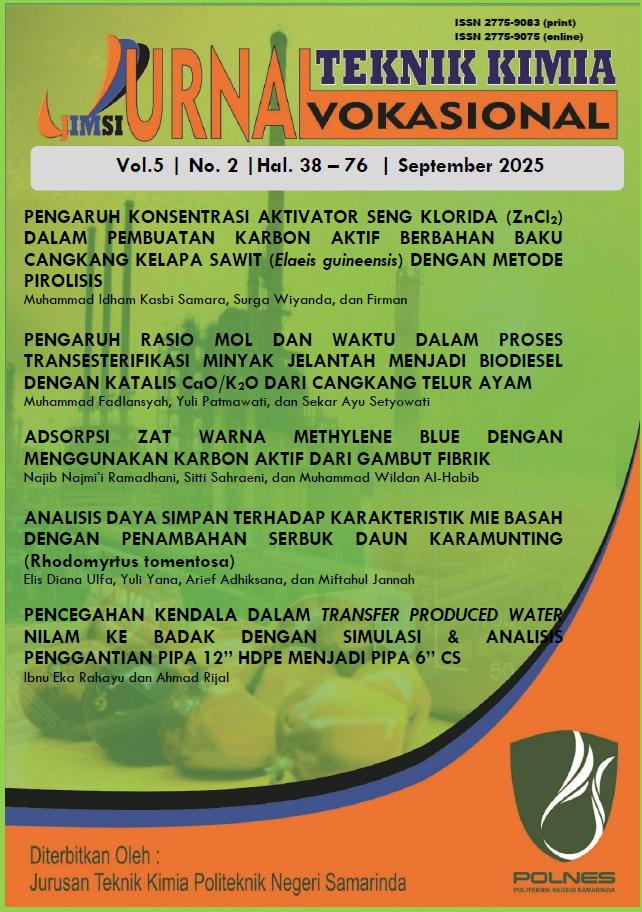
ANALISIS DAYA SIMPAN TERHADAP KARAKTERISTIK MIE BASAH DENGAN PENAMBAHAN SERBUK DAUN KARAMUNTING (Rhodomyrtus tomentosa)

 Abstract views: 3
,
Abstract views: 3
,
 pdf downloads: 5
Abstract
Karamunting (Rhodomyrtus tomentosa) is a wild plant that grows in tropical areas. Karamunting leaves contain secondary metabolite compounds such as flavonoids, saponins, quinones, tannins, steroids, hexasoic acid, gallic acid and glycosides which act as antioxidants and antibacterials so that they are used as natural preservatives. Preservatives can extend the shelf life of wet noodles. This study aims to determine the shelf life of wet noodles with the addition of karamunting leaf powder. In this study, karamunting leaves are dried to obtain karamunting leaf flour. Wet noodles are made from a ratio of wheat flour and karamunting leaf flour of 285 grams:15 grams and variations in storage time of 0 hours, 6 hours, 12 hours, 24 hours, 30 hours, 36 hours and 48 hours. Wet noodles are tested for their characteristics with parameters of moisture content, total microbes and organoleptic tests. The results showed that the storage time had an effect on the characteristics of wet noodles substituted with karamunting leaf flour. The lowest moisture content was found at 0 hours at 61.43% and the highest moisture content at 48 hours was 64.39%.The lowest microbial total at 0 hours was 2.30 x 10⁴ colonies/gram and the highest microbial total at 48 hours was 5.27 x 10⁵ colonies/gram. The average level of preference of the panelists liked the wet noodles substituted with karamunting leaves at a storage time of 36 hours.
Copyright (c) 2025 JURNAL TEKNIK KIMIA VOKASIONAL (JIMSI)

This work is licensed under a Creative Commons Attribution-NonCommercial-ShareAlike 4.0 International License.
Copyright Transfer Statement
The copyright of this article is transferred to JIMSI and when the article is accepted for publication. the authors transfer all and all rights into and to paper including but not limited to all copyrights in the Psikostudia. The author represents and warrants that the original is the original and that he/she is the author of this paper unless the material is clearly identified as the original source, with notification of the permission of the copyright owner if necessary. The author states that he has the authority and authority to make and carry out this task.
The author states that:
- This paper has not been published in the same form elsewhere.
- This will not be submitted elsewhere for publication prior to acceptance/rejection by this Journal.
A Copyright permission is obtained for material published elsewhere and who require permission for this reproduction. Furthermore, I / We hereby transfer the unlimited publication rights of the above paper to Jurnal Teknik Kimia Vokasional. Copyright transfer includes exclusive rights to reproduce and distribute articles, including reprints, translations, photographic reproductions, microforms, electronic forms (offline, online), or other similar reproductions.
The author's mark is appropriate for and accepts responsibility for releasing this material on behalf of any and all coauthor. This Agreement shall be signed by at least one author who has obtained the consent of the co-author (s) if applicable. After the submission of this agreement is signed by the author concerned, the amendment of the author or in the order of the author listed shall not be accepted.
Rights / Terms and Conditions Saved
- The author keeps all proprietary rights in every process, procedure, or article creation described in Work.
- The author may reproduce or permit others to reproduce the work or derivative works for the author's personal use or for the use of the company, provided that the source and the Informatika Mulawarman copyright notice are indicated, the copy is not used in any way implying the Jurnal Psikostudia approval of the product or service from any company, and the copy itself is not offered for sale.
- Although authors are permitted to reuse all or part of the Works in other works, this does not include granting third-party requests to reprint, republish, or other types of reuse.

Jurnal Teknik Kimia Vokasional by http://ejurnal.polnes.ac.id/index.php/jimsi licensed under a Creative Commons Attribution-ShareAlike 4.0 International License.