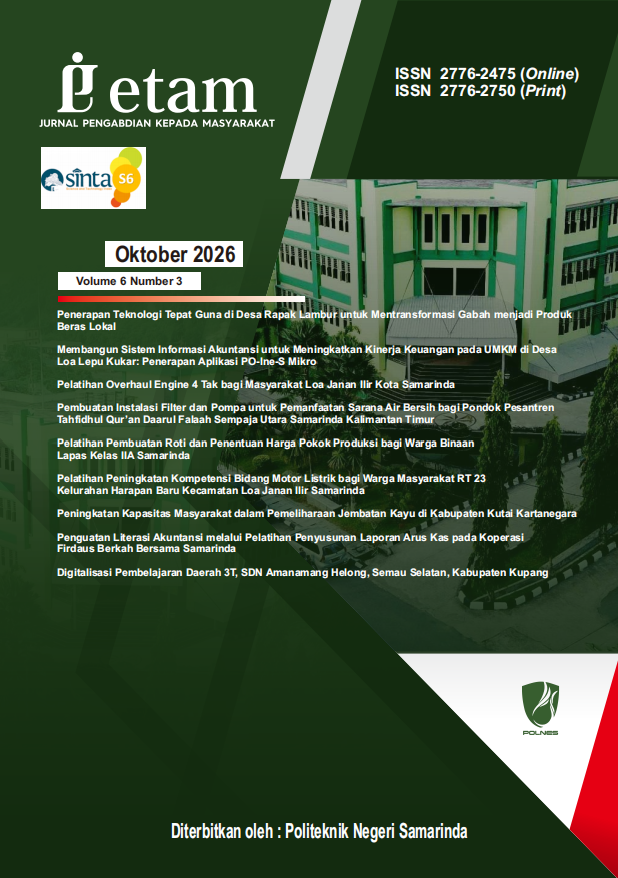
Penguatan Literasi Akuntansi melalui Pelatihan Penyusunan Laporan Arus Kas pada Koperasi Firdaus Berkah Bersama Samarinda
DOI:
https://doi.org/10.46964/299mmp58Keywords:
accounting literacy, cash flow statement, cooperative, direct method, community serviceAbstract
Koperasi Firdaus Berkah Bersama in Samarinda records its transactions in the halal bank application, but staff enter data by rote without understanding accounting concepts, and the application does not produce a cash flow statement. This community service program aimed to improve the accounting literacy of the cooperative's officers and members and their ability to prepare a simple cash flow statement. The program used participatory training, hands-on practice with the cooperative's own cash transactions, mentoring, and evaluation through a 20-item pretest and posttest covering four aspects: basic accounting literacy, simple cash recording, cash flow classification, and use of a monthly cash flow statement template. The training was held on 10–11 August 2026 with 16 participants. The share of correct answers rose from 39.06% to 77.50%, a normalized gain of 0.63 (medium), exceeding the 70% minimum target. The largest gain was in cash flow classification (35.00% to 86.25%; g = 0.79), while template use remained the weakest aspect (35.00% to 56.25%; g = 0.33) because the percentages of correct answers on the items assessing net cash flow, ending balance, and balance reconciliation did not increase. The evaluation showed improved conceptual understanding following practice-based training using the direct method, but calculation and reconciliation skills require follow-up mentoring and the development of financial champions within the cooperative.
References
Bruhn, M., Karlan, D., & Schoar, A. (2010). What capital is missing in developing countries? American Economic Review, 100(2), 629–633. https://doi.org/10.1257/aer.100.2.629
Dahmen, P., & Rodríguez, E. (2014). Financial literacy and the success of small businesses: An observation from a small business development center. Numeracy, 7(1), Article 3. https://doi.org/10.5038/1936-4660.7.1.3
Drexler, A., Fischer, G., & Schoar, A. (2014). Keeping it simple: Financial literacy and rules of thumb. American Economic Journal: Applied Economics, 6(2), 1–31. https://doi.org/10.1257/app.6.2.1
Hake, R. R. (1998). Interactive-engagement versus traditional methods: A six-thousand-student survey of mechanics test data for introductory physics courses. American Journal of Physics, 66(1), 64–74. https://doi.org/10.1119/1.18809
Kaiser, T., Lusardi, A., Menkhoff, L., & Urban, C. (2022). Financial education affects financial knowledge and downstream behaviors. Journal of Financial Economics, 145(2), 255–272. https://doi.org/10.1016/j.jfineco.2021.09.022
Karlan, D., & Valdivia, M. (2011). Teaching entrepreneurship: Impact of business training on microfinance clients and institutions. The Review of Economics and Statistics, 93(2), 510–527. https://doi.org/10.1162/REST_a_00074
Klapper, L., & Lusardi, A. (2020). Financial literacy and financial resilience: Evidence from around the world. Financial Management, 49(3), 589–614. https://doi.org/10.1111/fima.12283
Lusardi, A. (2019). Financial literacy and the need for financial education: Evidence and implications. Swiss Journal of Economics and Statistics, 155(1), 1–8. https://doi.org/10.1186/s41937-019-0027-5
Lusardi, A., & Mitchell, O. S. (2014). The economic importance of financial literacy: Theory and evidence. Journal of Economic Literature, 52(1), 5–44. https://doi.org/10.1257/jel.52.1.5
Lusardi, A., & Mitchell, O. S. (2023). The importance of financial literacy: Opening a new field. Journal of Economic Perspectives, 37(4), 137–154. https://doi.org/10.1257/jep.37.4.137
McKenzie, D., & Woodruff, C. (2014). What are we learning from business training and entrepreneurship evaluations around the developing world? The World Bank Research Observer, 29(1), 48–82. https://doi.org/10.1093/wbro/lkt007
Orpurt, S. F., & Zang, Y. (2009). Do direct cash flow disclosures help predict future operating cash flows and earnings? The Accounting Review, 84(3), 893–935. https://doi.org/10.2308/accr.2009.84.3.893
Ye, J., & Kulathunga, K. M. M. C. B. (2019). How does financial literacy promote sustainability in SMEs? A developing country perspective. Sustainability, 11(10), 2990. https://doi.org/10.3390/su11102990
Downloads
Published
Issue
Section
License
Copyright (c) 2026 Author and Journal

This work is licensed under a Creative Commons Attribution 4.0 International License.