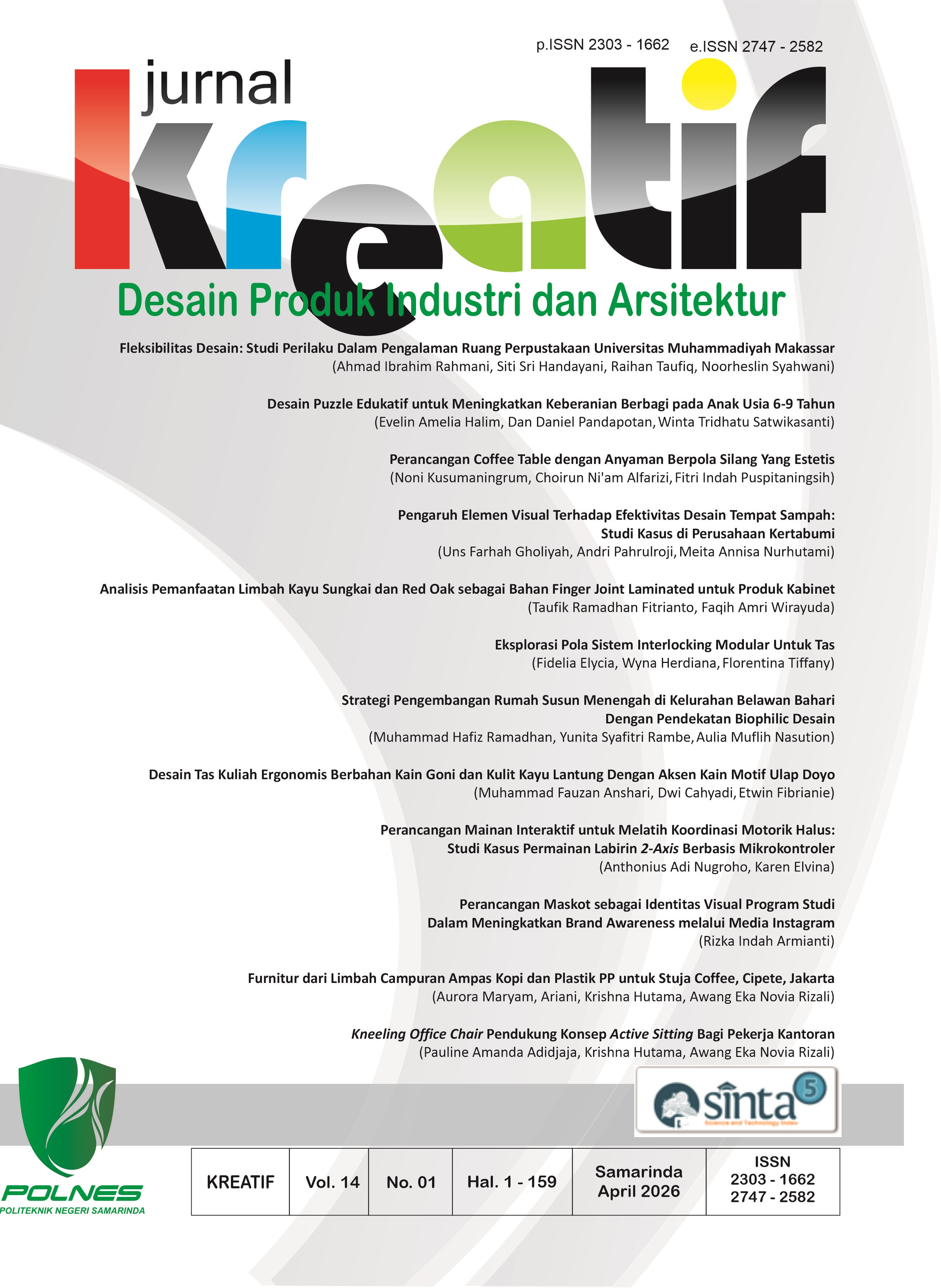
DESAIN PUZZLE EDUKATIF UNTUK MENINGKATKAN KEBERANIAN BERBAGI PADA ANAK USIA 6-9 TAHUN
Studi Kasus GKI Temanggung dan GKI Temanggung Bajem Kranggan
DOI:
https://doi.org/10.46964/jkdpia.v14i1.1454Keywords:
Rapid Ethnography, morphological chart, educational toys, sharing values, Bible storiesAbstract
This design project was motivated by the difficulty children aged 6–9 experience in understanding the value of sharing through engaging play media. Children in the concrete operational cognitive stage require an approach that enables them to grasp abstract concepts such as sharing through real-life experiences. The objective of this study is to design an educational toy in the form of a puzzle that naturally and collaboratively encourages children to share. The research employed a qualitative approach using Rapid Ethnography through observation, interviews, and literature review, followed by a design method using a morphological chart to explore combinations of form, gameplay mechanisms, and narratives based on biblical stories. The design outcome resulted in an MDF-based educational puzzle in the form of a biblical diorama with interactive mechanisms. Evaluation was conducted through prototype testing and feedback from Sunday School teachers. The resulting design attributes include: (1) functional and physical attributes, namely a tangible puzzle that can be played by both boys and girls, individually or in groups; (2) safety attributes, with non-toxic materials and rounded edges; (3) mechanical attributes, which provide each child with the opportunity to contribute concretely to puzzle completion; (4) play experience attributes, which encourage natural discussion, reflection, and sharing behavior; and (5) a reward system, namely collective appreciation once the puzzle is completed and the biblical story is conveyed. In conclusion, this design successfully produced an interactive educational toy that is not only safe and enjoyable but also effective in instilling the value of sharing in children aged 6–9 through collaborative play.
Downloads
References
Amalia, D. (2023). Analisis Penggunaan Media Puzzle Terhadap perkembangan berpikir Logis Anak usia 5-6 Tahun di TK Ceria Desa Terasa KEC. Sinjai Barat, Kab Sinjai. Retrieved from https://repositori.uin-alauddin.ac.id/26194/1/Analisis Penggunaan Media Puzzle terhadap Perkembangan Berpikir Logis Anak Usia 5-6 Tahun di TK Ceria Desa Terasa Kab. Sinjai.pdf
Fan, Y., et al. (2024). Beyond play: a comparative study of multi-sensory and traditional toys in child education. Frontiers in Education, 9. doi:10.3389/feduc.2024.1182660
Girsang, M. B., & H, R. (2021). Desain Permainan 3D Puzzle Dengan Bentuk Hewan Khas Kalimantan. Jurnal Kreatif: Desain Produk Industri Dan Arsitektur, 9(1), 44–51. doi:10.46964/jkdpia.v9i1.148
Humaira, P. (2023). Penerapan Media Pembelajaran Talking Stick dalam meningkatkan keberanian anak usia dini di TK Cingoran. Retrieved from https://repository.ar-raniry.ac.id/31186/1/skripsi pretina Humaira.pdf
Insani, H. (2024). Strategi Efektif untuk Meningkatkan Keterampilan Berbahasa pada Anak Usia Dini Pemalu Melalui Pendekatan Teori Zona Perkembangan Proksimal (ZPD) Vygotsky. Jurnal Pendidikan Anak Usia Dini, 2(2). doi:10.47134/paud.v2i2.1272
Istiqomah, L. R., et al. (2024). Pengembangan Puzzle Book “Aktivitas Kiki” Dalam Meningkatkan Bahasa Ekspresif Anak 4-5 Tahun. In Kumara Cendekia, 12(3). doi:10.20961/kc.v12i3.89523
Khadijah, & Rustam. (2020). Perkembangan Kemampuan Dasar Anak Usia Dini (Samsidar (ed.)): Perdana.
Khairunnisa, F. (2021). Peran Orang Tua Dalam Mengembangkan Perilaku Berbagi Dan Menolong Pada Anak Usia Dini. Jurnal AUDHI, 4(1), 33–42. Retrieved from https://jurnal.uai.ac.id/index.php/AUDHI
Kurnia, R. (2012). Konsepsi Bermain dalam menumbuhkan Kreativitas Pada Anak Usia Dini. EDUCHILD, 1(1). Retrieved from https://media.neliti.com/media/publications/22936-ID-konsepsi-bermain-dalam-menumbuhkan-kreativitas-pada-anak-usia-dini.pdf
Ma’rufi, A., et al. (2018). Hubungan Sikap Berani dengan Kepercayaan Diri pada Kegiatan Senam Irama. Pedadidaktika: Jurnal Ilmiah Pendidikan Guru Sekolah Dasar, 5(3), 287–296. Retrieved from http://ejournal.upi.edu/index.php/pedadidaktika/index
Permana, D., & Djatmiko, M. D. (2021). Perancangan Mainan Anak Usia 3-6 Tahun Berbasis Metode Pendidikan Montessori. Retrieved from https://eproceeding.itenas.ac.id/index.php/fad/article/view/209/150
Rohayani, H. (2023). Model Mengajarkan Cerita Alkitab Kepada Anak Sekolah Minggu Usia 6-9 Tahun. Charistheo: Jurnal Teologi Dan Pendidikan Agama Kristen, 2(2). Retrieved from http://e-journal.anugrah.ac.id/index.php/JCH
Sansena, M. A. (2022). Penerapan Proses Belajar Matematika Sesuai Dengan Teori Perkembangan Kognitif Jean Piage Jurnal Ilmiah Penelitian Dan Kependidikan. Retrieved from https://widyasari-press.com/wp-content/uploads/2022/12/5.-Mona-Anju-Sansena-Penerapan-Proses-Belajar-Matematika-Sesuai-Dengan-Teori-Perkembangan-Kognitif-Jean-Piaget.pdf
Shella Rhodinia, et al. (2023). Permalasahan Media Pembelajaran IPS Yang Kurang Variatif Dan Strategi Pemecahannya. ALADALAH: Jurnal Politik, Sosial, Hukum Dan Humaniora, 2(1), 25–37. doi:10.59246/aladalah.v2i1.613
Siddiq, M., & Salama, H. (2019). Etnografi Sebagai Teori dan Metode. KORDINAT, 8(1). doi:10.15408/kordinat.v18i1.11471
Sinta Zakiyah, et al. (2024). Perkembangan Anak pada Masa Sekolah Dasar. DIAJAR: Jurnal Pendidikan Dan Pembelajaran, 3(1), 71–79. doi:10.54259/diajar.v3i1.2338
Sulistyowati, R., et al. (2022). Profil Anak Usia Dini 2022. Badan Pusat Statistik. Retrieved from www.flaticon.com
Syaodih, E. (2014). Perkembangan Anak Usia Dini (Usia 6-8 Tahun). Strategi Dan Implementasi Pelaksanaan Pendidikan Karakter. Retrieved from http://file.upi.edu/Direktori/FIP/JUR._PGTK/196510011998022-ERNAWULAN_SYAODIH/perk_anak__6-8_th_.pdf
Tiofani, A., et al. (2024). Kajian Dampak Positif Puzzle Terhadap Kemampuan Spasial dan Motorik Anak. Jurnal Kreatif : Desain Produk Industri dan Arsitektur, 12(1). doi:10.46964/jkdpia.v12i1.678
Wahyujati, B. B. (2022). Aplikasi metode Morphological Chart pada perancangan Robot Belajar Baca (ROBOCA) untuk anak usia dini. Pengetahuan Dan Perancangan Produk, 5(2), 67–74.
Wibowo Satria, W., et al. (2019). Rekayasa Board Game Dengan Sumber Ide Cerita Alkitab.
Downloads
Published
Issue
Section
License
Authors who publish with this journal agree to the following terms:
- Copyright on any article is retained by the author(s).
- The author grants the journal, right of first publication with the work simultaneously licensed under a Creative Commons Attribution License that allows others to share the work with an acknowledgment of the work’s authorship and initial publication in this journal.
- Authors are able to enter into separate, additional contractual arrangements for the non-exclusive distribution of the journal’s published version of the work (e.g., post it to an institutional repository or publish it in a book), with an acknowledgment of its initial publication in this journal.
- Authors are permitted and encouraged to post their work online (e.g., in institutional repositories or on their website) prior to and during the submission process, as it can lead to productive exchanges, as well as earlier and greater citation of published work.
- The article and any associated published material is distributed under the Creative Commons Attribution-ShareAlike 4.0 International License