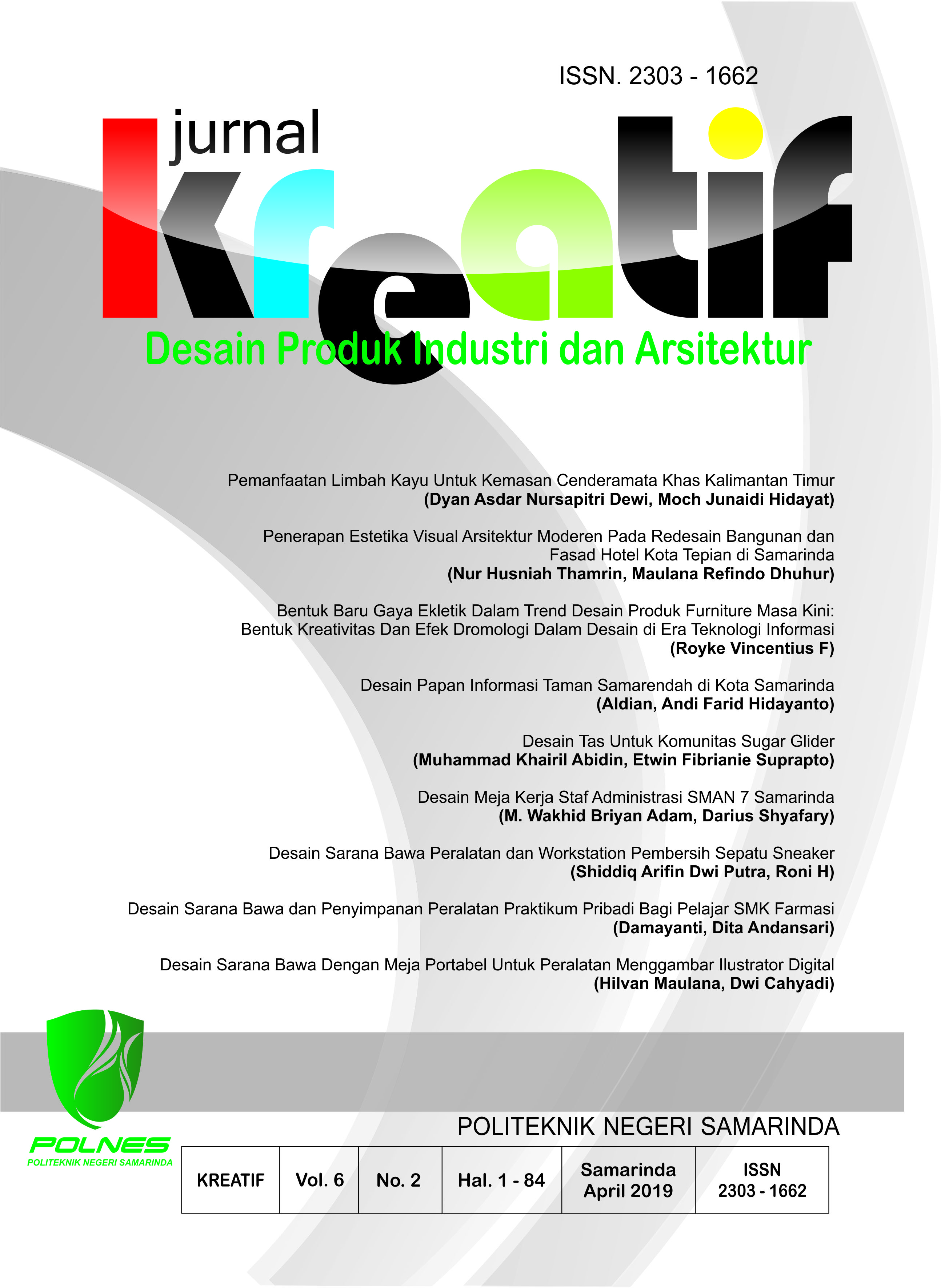
DESAIN SARANA BAWA DAN PENYIMPANAN PERALATAN PRAKTIKUM PRIBADI BAGI PELAJAR SMK FARMASI
DOI:
https://doi.org/10.46964/jkdpia.v6i2.28Keywords:
Desain Sarana Bawa, SMK Farmasi Samarinda, Perlatan PraktikumAbstract
ABSTRAK
SMK Farmasi memiliki mata pelajaran yang mengharuskan pelajar melaksanakan praktikum di labolatorium. Kegiatan praktikum mengharuskan pelajar untuk memiliki peralatan pribadi yang wajib dibawa. Saat ini sebagai sarana bawa dan penyimpanannya, pelajar SMK Farmasi menggunakan kotak berbahan plastik yang biasa digunakan untuk tempat makanan. Hal inilah yang melatarbelakangi munculnya ide rancangan ini. Serta permasalahan yang ada saat ini adalah saat jadwal praktikum berlangsung, pelajar SMK Farmasi banyak membawa peralatan, diantaranya peralatan yang mudah pecah maupun yang tidak mudah pecah, namun belum adanya sarana bawa khusus untuk peralatan tersebut. Adapun tujuan rancangan ini adalah untuk mendesain sebuah sarana bawa yang dapat melindungi peralatan-peralatan yang dibawa, diantara lain; pipet tetes, cawan porselin, kaca arloji, batang pengaduk, tissue, lap, sendok tanduk, gunting, kayu penjepit, spatula, forcep, sikat tabung, etiket, label ni, zak plastik, dan botol kaca. Dengan metode perancangan yang sudah dilakukan diantaranya; pengumpulan data analisis, alternatif desain, pengembangan desain dari alternatif terpilih, serta desain akhir. Sehingga dihasilkan desain sarana bawa dan penyimpanan peralatan praktikum bagi Pelajar SMK Farmasi Samarinda yang memiliki sekat-sekat khusus peralatan praktikum pribadi Pelajar SMK Farmasi Samarinda, dan menggunakan gaya desain modern, serta sistem bukaan menggunakan resleting, dengan warna biru dan putih yang melambangkan ciri SMK Farmasi.
Kata Kunci : Desain Sarana Bawa, SMK Farmasi Samarinda, Perlatan Praktikum
ABSTRACT
Pharmacy Vocational Schools have subjects that require students to carry out practical work in laboratories. Practical activities require students to have personal equipment that must be carried. Currently as a means of carrying and storing it, students of Pharmacy Vocational Schools use plastic boxes that are used for food. This is the background of the emergence of this design idea. As well as the problems that exist today are when the practicum schedule takes place, many Pharmacy Vocational students carry equipment, including fragile and non-fragile equipment, but there is no special means of carrying it for the equipment. The purpose of this design is to design a vehicle that can protect the equipment carried, among others; drop pipette, porcelain cup, watch glass, stirring rod, tissue, cloth, horn spoon, scissors, wooden tongs, spatulas, forceps, tube brushes, etiquette, labels, plastic bags, and glass bottles. With the design method that has been carried out including; analysis of data collection, alternative design, design development of selected alternatives, and final design. So that the design of the carrying facilities and storage of practicum equipment for Samarinda Pharmacy Vocational School students who have special barriers to the personal practicum equipment of Samarinda Pharmacy Vocational School students, and using a modern design style, and openings system using zippers, blue and white symbolize the characteristics of Pharmacy Vocational Schools.
Keywords: Carrying Facilities Design, Samarinda Pharmacy Vocational School, Practical Equipment
Downloads
Downloads
Published
Issue
Section
License
Authors who publish with this journal agree to the following terms:
- Copyright on any article is retained by the author(s).
- The author grants the journal, right of first publication with the work simultaneously licensed under a Creative Commons Attribution License that allows others to share the work with an acknowledgment of the work’s authorship and initial publication in this journal.
- Authors are able to enter into separate, additional contractual arrangements for the non-exclusive distribution of the journal’s published version of the work (e.g., post it to an institutional repository or publish it in a book), with an acknowledgment of its initial publication in this journal.
- Authors are permitted and encouraged to post their work online (e.g., in institutional repositories or on their website) prior to and during the submission process, as it can lead to productive exchanges, as well as earlier and greater citation of published work.
- The article and any associated published material is distributed under the Creative Commons Attribution-ShareAlike 4.0 International License